
Budget a moderate amount in all-in cost per order for U.S. 3PL fulfillment in 2026, with the range driven by order volume, product size, and how many accessorial fees a provider includes in its rate card. Survey data pegs pick-and-pack fees at an average of $3.20 per order, with pallet storage averaging just over $20 a month. Use the modeling method below to check any quote against these numbers before you sign.
TL;DR:
- Storage costs typically range from $18 to $25 per pallet per month, with larger brands paying proportionally less due to volume discounts.
- Hidden fees such as peak-season surcharges, long-term storage penalties, and undisclosed dimensional-weight markups can significantly inflate total fulfillment costs.
- Calculating true cost per order requires including all fees—pick and pack, storage, receiving, accessorials, setup amortization, and minimums—divided by total shipped orders.
- Request detailed, itemized quotes and sample invoices from providers to accurately compare full fee structures and model costs before signing contracts.
- The most costly issues stem from unbounded fees, like rate escalators and peak surcharges, which can quietly triple or quadruple your actual fulfillment expenses.
Table of Contents
- What Goes Into 3PL Pricing? A Line-By-Line Fee Breakdown
- How Do You Calculate True Cost Per Order?
- How Should You Compare Competing 3PL Quotes?
- What Contract Terms Should Make You Walk Away?
- How Envio3pl Structures Transparent 3PL Pricing
- Why Most 3PL Pricing Advice Misses the Point
- Get a Transparent 3PL Quote Built Around Your Actual Numbers
- Sources
What Goes Into 3PL Pricing? A Line-By-Line Fee Breakdown
Every 3PL rate card breaks into the same core categories, even when providers label them differently. Knowing what each line actually covers is the difference between comparing quotes accurately and getting blindsided by an invoice that looks nothing like the sales pitch.
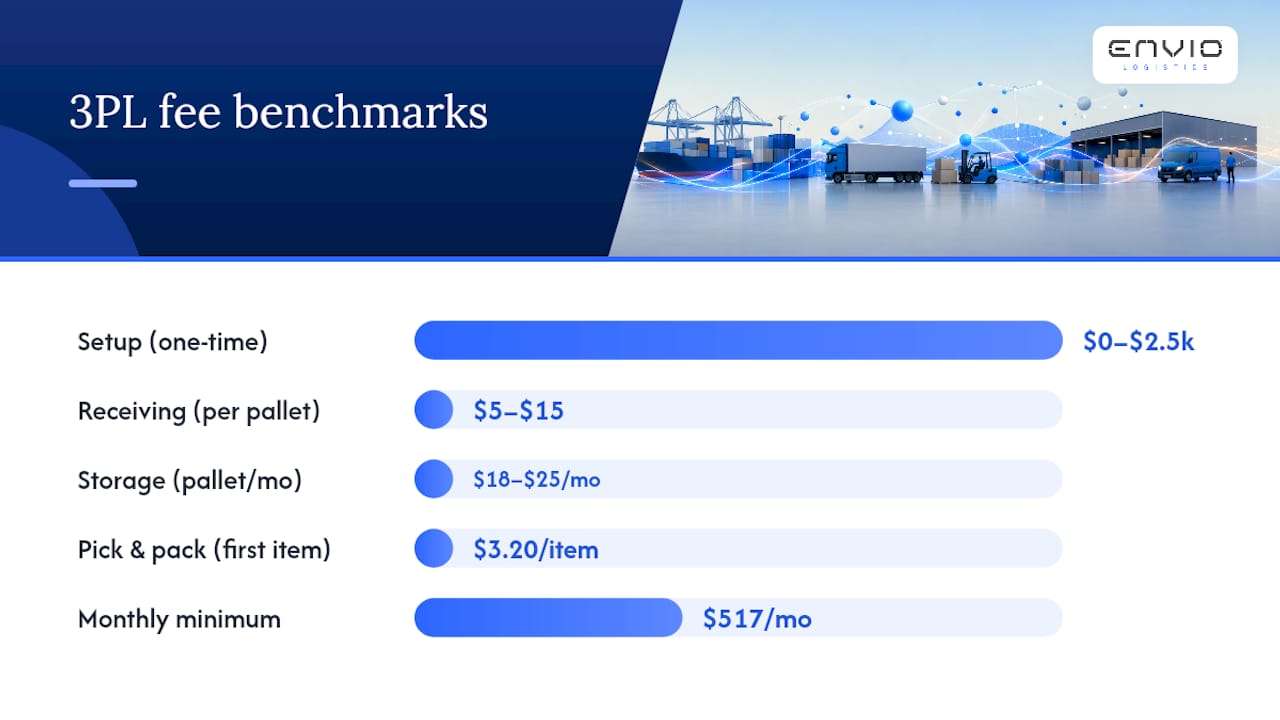
Setup and onboarding fees. Most providers charge a one-time fee to build your account, map your SKUs, and configure integrations with Shopify, Amazon, or WooCommerce. These run anywhere from $0 to $2,500 depending on catalog complexity. Ask if this is waivable. It often is.
Receiving (inbound) fees. You pay to check in incoming inventory, typically billed per pallet or per hour. Expect $5 to $15 per pallet, with loose cartons or floor-loaded containers costing more because they take longer to process.
Storage fees. This is where “3pl storage fees” get confusing fast, because providers bill by pallet, bin, or cubic foot. Pallet storage averages $20.17 per pallet per month, with most quotes landing in the $18 to $25 pallet storage cost range. Bin storage for small SKUs runs lower per unit but adds up with high SKU counts.
Pick and pack fees. This covers labor to pull and pack an order. The survey average sits at $3.20 for the first item, with additional items typically running $0.25 to $0.85 each. Multi-item orders cost more, which matters if you sell bundles or kits.
Shipping and carrier passthroughs. 3PLs typically pass through negotiated carrier rates, sometimes with a small markup. Dimensional weight pricing can spike this line unexpectedly for bulky, lightweight products.
Returns processing. Reverse logistics fees cover inspection, restocking, and disposal decisions, usually billed per unit or per return.
Accessorials. This is the catchall category, and it’s where costs balloon. Kitting, relabeling, custom packaging, and account management fees can add 20 to 40 percent to a quoted rate if you’re not watching closely.
Watch for these four traps specifically:
- Peak-season surcharges applied without a written cap or defined date range
- Long-term storage penalties triggered after 60 to 90 days, often at 2 to 3 times the normal rate
- Dimensional-weight markups on shipping that aren’t disclosed until the first invoice
- Monthly minimums that quietly inflate your effective cost per order at low volume
Average monthly minimum fees rose to roughly $517 in 2025, up from $337.50 the year before — a jump that hits smaller brands hardest since it’s a fixed cost spread over fewer orders.
Pro Tip: Ask every provider to itemize accessorials on a sample invoice, not just the rate card. Rate cards show the numbers a provider wants you to see; invoices show what you’ll actually pay.
How Do You Calculate True Cost Per Order?
The formula is simple, but most brands leave out the fees that matter most:
True CPO = (Pick & pack + Storage + Receiving + Accessorials + Amortized setup fees + Any shortfall to reach the monthly minimum) ÷ Total orders shipped
Your numerator needs every fee that hits your invoice, not just the pick fee quoted in the sales call. Your denominator is actual orders shipped that month, not orders placed.
Here’s how that plays out for two different brands.
Example A: A brand shipping 800 orders a month. At a quoted pick fee of $3.50 and a monthly minimum of $2,000, this brand’s actual spend on fulfillment labor alone (800 x $3.50 = $2,800) already exceeds the minimum, so the minimum doesn’t distort things much. But add a $1,500 setup fee amortized over the first six months ($250/month), plus storage for 10 pallets at $20 each ($200) and the math shifts:
| Cost component | Monthly amount |
|---|---|
| Pick & pack (800 orders x $3.50) | $2,800 |
| Storage (10 pallets x $20) | $200 |
| Amortized setup ($1,500 ÷ months) | $250 |
| Receiving (2 pallets x $10) | $20 |
| Total | $3,270 |
| True CPO (÷ 800 orders) | $4.09 |
Example B: A brand shipping 7,000 orders a month. At this volume, RFP data shows median order fees drop to around $1.44, reflecting real volume leverage. Storage for 40 pallets at $20 runs $800, and the setup fee is long since amortized to zero.
Brand A pays nearly three times more per order than Brand B, almost entirely because of volume and amortized fixed costs. That gap should shape how you negotiate. If you’re shipping under 1,000 orders a month, your leverage is in waiving setup fees and minimums, not chasing a lower pick rate.
How Should You Compare Competing 3PL Quotes?
Quotes rarely arrive in comparable formats, which is exactly how providers win deals on rate cards that look cheap and invoice expensive. Fix that by requesting the same set of documents from every provider before you compare anything.
Request in every RFP:
- A full rate card covering every fee category, not a summary sheet
- A sample invoice from an existing client at a similar order volume
- Written peak-season surcharge schedules with specific date ranges
- The long-term storage threshold (60 days? 90 days?) and the surcharge multiplier
- Integration and onboarding fee terms, including any waiver conditions
- Contract length, auto-renewal terms, and offboarding cost structure
Once you have these, run every quote through the same 90-day forecast: project your actual order volume, average order size, and pallet count, then apply each provider’s full rate card to get a true CPO. A provider quoting a low pick fee while charging premium storage rates can end up costing more overall than one with a higher pick fee and honest storage pricing. Model the whole invoice, never a single line item.
Negotiation priorities, in order:
- Cap peak-season surcharges in writing before you sign
- Waive or reduce the monthly minimum for your first two to three months
- Push for integration fee waivers, especially if you’re bringing volume from day one
- Ask for full transparency on carrier passthroughs, meaning cost plus a disclosed flat markup, not a hidden percentage
Pro Tip: Never negotiate storage and pick fees in isolation. A provider who won’t budge on pick fees will often flex on storage tiers or waive the setup fee entirely. Ask for the whole package to move, not one line.
What Contract Terms Should Make You Walk Away?
Some contract clauses cost you money quietly for years. Others blow up your Q4 budget without warning. Here’s what to flag before signing anything.
- Auto-renewal with no notice window. If you can’t exit without 90 days’ notice, you’re locked in even when service quality drops.
- Rate escalators with no cap. An annual increase tied to CPI sounds reasonable until it compounds for three years straight.
- Opaque carrier passthroughs. If the contract doesn’t specify “cost plus a flat markup,” assume you’re paying a hidden percentage on every shipment.
- Uncapped inventory offboarding fees. Some providers charge per pallet to release your own inventory if you leave, sometimes at inflated rates timed for your busiest season.
- Undefined peak-season windows. Surcharges can add 15 to 30 percent to your fulfillment costs if the contract doesn’t specify exact dates and caps.
Propose specific counter-language for each: cap the annual escalator at 3 percent, define carrier passthroughs as cost plus a flat audit fee, and cap offboarding costs at cost plus 10 percent or $5,000, whichever is lower.
A simple four-week timeline gets you ready before contracts renew or Q4 hits:
- Week 1: Pull 90 days of invoices and map every charge against your current rate card.
- Week 2: Benchmark those numbers against current market rates and request updated quotes from two to three alternative providers.
- Week 3: Bring discrepancies to your account manager as a reconciliation conversation, not a threat.
- Week 4: Finalize any concessions in writing before you renew.
How Envio3pl Structures Transparent 3PL Pricing
Envio3pl was built around the idea that a rate card should look like your invoice. No long-term contracts means you’re never locked into a rate that stops making sense. Same-day shipping for orders placed by 1 PM CST keeps your cost-per-order math predictable instead of inflated by rush fees. And a live inventory portal means the storage numbers on your dashboard match what shows up on your bill.
That transparency maps directly onto the fee categories covered above:
- Storage costs tracked in real time, not estimated after the fact
- SKU profitability analysis that shows which products are actually worth the storage spend
- No opaque accessorial stacking, since pricing is quoted per pallet, order, or project based on your actual operation
If you want to see how these numbers would look for your own order volume, a sample rate card is the fastest way to check your math.
Why Most 3PL Pricing Advice Misses the Point
The conventional advice on 3PL pricing treats it like a shopping problem: find the lowest pick fee, sign, move on. That’s backward. The research here says the real cost driver isn’t any single line item. It’s whether a provider’s full invoice matches its rate card, and whether your contract has caps on the fees that spike during Q4.
Brands get burned less by high prices than by invisible prices: an uncapped escalator, an undefined peak window, a monthly minimum that quietly doubles their effective CPO at low volume. Chasing a $0.20 discount on pick fees while ignoring a 30 percent uncapped peak surcharge is optimizing the wrong variable.
If you take one thing from this guide, model your total CPO with a 90-day forecast before you compare any two providers, and read the offboarding clause before the pricing page. Most brands do the opposite: they negotiate hard on the number they can see and sign blind on the one they can’t.
— Reddog
Get a Transparent 3PL Quote Built Around Your Actual Numbers
Envio3pl exists for brands tired of rate cards that don’t match their invoices. Instead of an all-in-one enterprise contract or a patchwork of vendors that obscure where your margin actually goes, you get one partner handling warehousing, retail prep, and direct-to-consumer fulfillment with pricing quoted against your real order volume and SKU count.
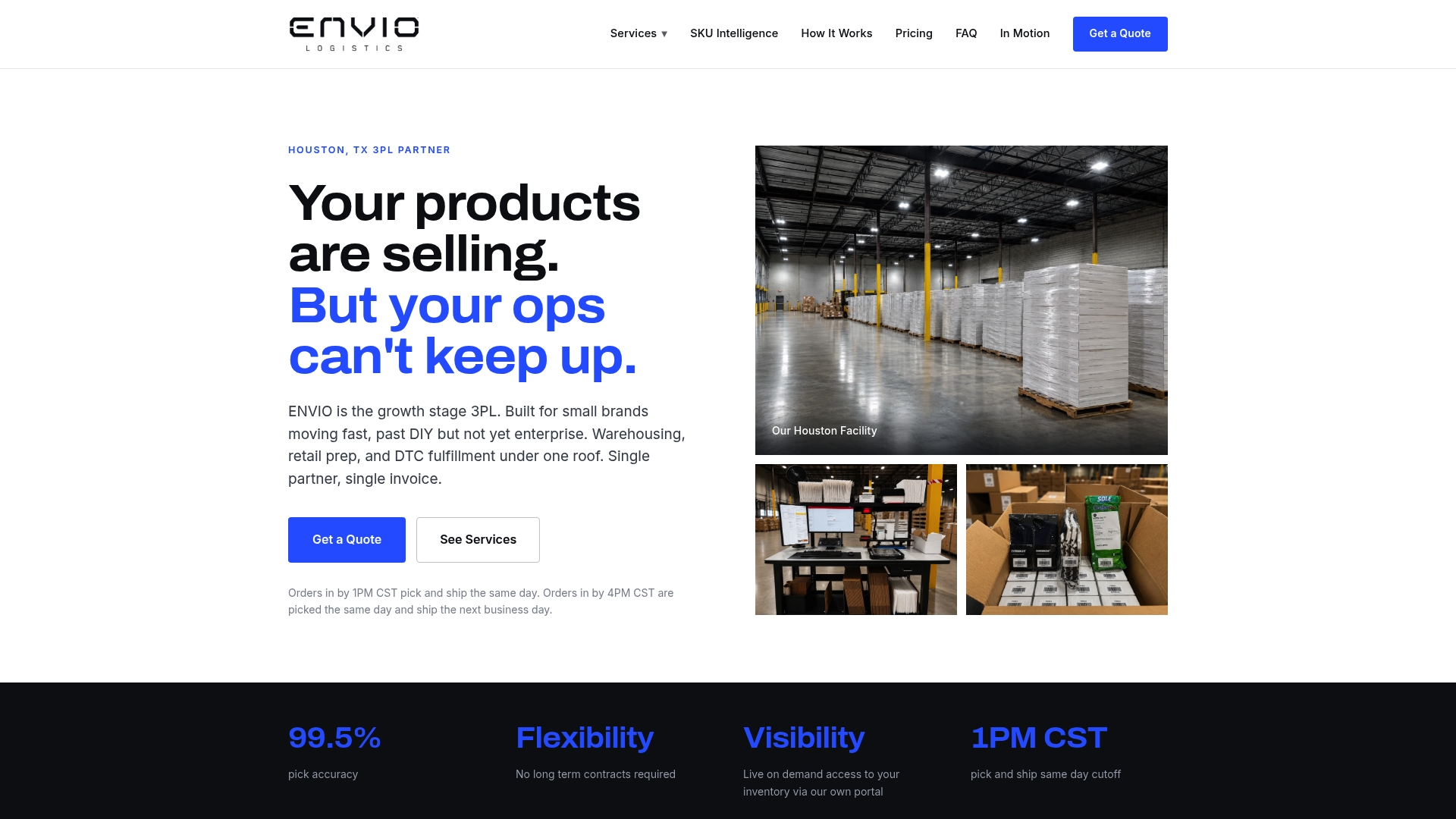
There’s no long-term contract locking you into last year’s rate card, and the live inventory portal means the storage numbers you see match what lands on your invoice. If you’re comparing quotes or auditing a current 3PL relationship, request a sample rate card from Envio3pl’s services and pricing page and run it through the cost-per-order formula above. If retail prep for Amazon or Walmart is part of your operation, the Amazon and Walmart prep page breaks down those fees specifically. Send over your SKU count and order volume, and get a quote built on numbers you can verify yourself.
Sources
- 3PL Pricing and Rates Guide (The Fulfillment Advisor / Fulfill)
- How to Audit and Optimize Your 3PL Contract Before Q4 2026 – Ecommerce Times
- Warehousingcosts
- 3PL Costs Explained: Hidden Fulfillment Fees Guide 2026 | Niblin
0 comments