
Dock-to-stock time measures the hours between a shipment hitting your dock and that inventory becoming available to pick, and it directly controls how fast you can fulfill orders. Best-in-class operations run under 3.5 hours, while most warehouses land somewhere between 4 and 12 hours. Every hour beyond that ties up cash in inventory you can’t sell yet and pushes fulfillment delays downstream.
TL;DR:
- Most warehouses take between 4 and 12 hours to complete dock-to-stock, with best-in-class operations aiming under 3.5 hours.
- The main delay causes are carrier wait times and manual processing, which can be addressed through scheduling discipline and process improvements.
- Implementing low-cost tactics like ASN compliance, dynamic scheduling, and mobile scanning can reduce dock-to-stock time by 20 to 40%.
- Longer wait times indicate scheduling and carrier coordination issues, whereas extended processing reflects problems in ASN data or manual workflows.
- Improving inbound visibility and automation, especially for high-volume lanes, significantly accelerates the dock-to-stock process.
Table of Contents
- What Is Dock-to-Stock Time and How Do You Calculate It?
- What Is a Good Dock-to-Stock Time Benchmark?
- What Causes Slow Dock-to-Stock Time?
- How Do You Reduce Dock-to-Stock Time?
- How Envio Approaches Inbound Efficiency
- What Should You Fix First?
- Let Envio Handle Your Inbound Receiving
- Sources
- FAQ
What Is Dock-to-Stock Time and How Do You Calculate It?
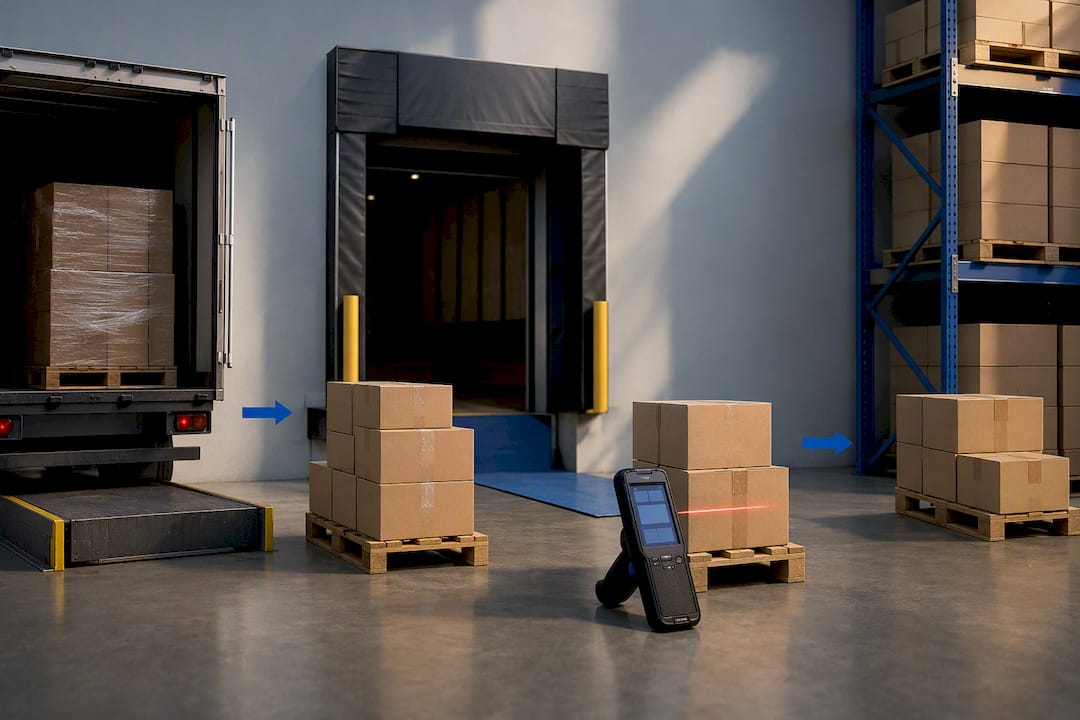
Dock-to-stock time is the elapsed time from when goods physically arrive at your dock to when they’re recorded as available in your inventory system. APQC defines this measure in hours, and deliberately includes wait time, not just active processing.
The formula is simple: Dock-to-stock time = System-available timestamp minus dock-arrival timestamp.
Getting the clock rules right matters more than the math. Set these start and stop points before you measure anything:
- Start: Physical trailer arrival at the dock door, not the appointment time on the schedule.
- Stop: The moment inventory shows as available in your warehouse management system (WMS), not when the pallet lands in a rack.
- Unit: Pick receipt, pallet, or line item and stay consistent. Mixing units across reports produces numbers nobody can compare.
Report the median, not the average. KPI Depot’s guidance on this measure backs the same recommendation: pick a unit, stick with it, and use median to keep outliers from distorting your target.
What Is a Good Dock-to-Stock Time Benchmark?
Best-in-class operations complete dock-to-stock in under 3.5 hours, according to the 2025 WERC DC Measures Report cited by Extensiv, which also lists this metric among the five core KPIs every 3PL should track.
Benchmark snapshot: Best-in-class 3PLs run dock-to-stock under 3.5 hours. Typical warehouses land at 4 to 12 hours, and anything stretching past 12 to 48 hours usually signals a wait-time or processing bottleneck worth investigating.
Your realistic target depends heavily on operation type:
- eCommerce fulfillment tends to run tighter because same-day and next-day shipping commitments force fast putaway.
- 3PL operations handling mixed clients often average in the middle of the range, since supplier compliance varies by brand.
- Manufacturing inbound can tolerate longer windows if raw materials feed production schedules rather than direct-to-order fulfillment.
- Cold chain and regulated goods usually run slower due to mandatory inspection or temperature-logging steps.
Track weekly, not monthly. Monthly averages bury the exact problem days you need to see.
What Causes Slow Dock-to-Stock Time?
Most dock-to-stock delays split cleanly into two buckets: time freight spends waiting, and time your team spends processing it. Knowing which one is dragging your number down changes everything about where you invest.
Wait-side causes usually trace back to:
- Carrier dwell time from missed or unscheduled appointments.
- Dock door congestion during peak receiving windows.
- Shift handoffs where receipts sit untouched between crews.
Industry analysis on warehouse receiving points to appointment mismatches and carrier coordination gaps as a major share of total elapsed time, meaning the fix is scheduling discipline, not faster receivers.
Processing-side causes typically include:
- Missing or incomplete advance shipping notices (ASNs) forcing manual data entry.
- Paper-based receiving that delays system updates by hours.
- QA holds or putaway logic that sends product to the wrong zone the first time.
To diagnose which side is hurting you, segment your receipts by supplier, shift, and receipt type, then run an “age of receipts” report weekly. Compare median wait time against median processing time separately. The gap between them tells you exactly where to spend your next dollar.
Pro Tip: Before investing in new technology, pull two weeks of timestamped receipt data and split it into wait versus processing hours by hand. Most teams are surprised to find the bottleneck isn’t where they assumed.
How Do You Reduce Dock-to-Stock Time?
Cutting dock-to-stock time works best as a staged rollout: fix cheap process gaps first, then layer in automation once the fundamentals are solid.
Quick wins (low cost, fast payback):
- Require ASNs from every supplier and reject non-compliant shipments when contracts allow it.
- Standardize supplier labeling so barcodes scan on the first pass instead of triggering manual lookups.
- Set dynamic dock scheduling with staggered appointment windows to reduce trailer queuing.
Mid-term projects:
- Deploy mobile scanning at the dock door to capture arrival and putaway timestamps automatically, eliminating the data lag that comes from end-of-shift manual logging.
- Redesign staging layout so high-velocity SKUs sit closer to putaway lanes, cutting travel distance.
- Build real-time labor orchestration rules that trigger surge staffing when inbound volume spikes.
Capital investments:
- Guided putaway or AI-driven slotting in your WMS, which vendor and practitioner data suggest can cut travel time and putaway labor by 20 to 40% when paired with intelligent slotting.
- RFID tagging for high-volume receiving lanes where barcode scanning creates a bottleneck.
| Tactic | Investment level | Typical impact |
|---|---|---|
| ASN compliance + supplier labeling | Low | Fewer manual entry delays |
| Dynamic dock scheduling | Low to medium | Less carrier dwell and congestion |
| Mobile scanning at dock | Medium | Eliminates timestamp lag |
| Guided putaway / AI slotting | Medium to high | 20 to 40% less putaway labor |
| RFID tagging | High | Faster high-volume receiving |
Pro Tip: Run ASN compliance and dock scheduling changes for 30 days before touching your WMS. Process fixes are cheap to test and often account for most of the improvement automation would otherwise get credit for.
One Hopstack case example shows a facility combining ASN integration, dynamic scheduling, mobile scanning, and putaway optimization to cut dock-to-stock from roughly 10 hours down to about 2. Results like that depend on how many of these levers you pull at once, not just one fix in isolation.
How Envio Approaches Inbound Efficiency
A live inventory portal changes how fast a warehouse team can prioritize putaway. When receiving staff can see SKU velocity and current stock levels in real time, they know which pallets need to move to a pick location first and which can wait in overflow. Envio Logistics, Inc pairs that visibility with SKU profitability analysis, so clients aren’t just moving inventory faster, they’re moving the right inventory faster.
Combining ASN compliance, barcode scanning, and structured putaway rules tends to produce meaningful improvement over unmanaged receiving, based on the same practitioner patterns documented across the industry.
- Results vary by SKU mix, supplier compliance, and receiving volume.
- An inbound assessment can identify where your specific bottlenecks sit before you commit to a fix.
What Should You Fix First?
Score your inbound operation honestly before spending on anything. If your wait-time segment dwarfs your processing-time segment, fix scheduling and carrier coordination before buying software. If processing time is the drag and receipts sit for hours after arrival, ASN compliance and mobile scanning will move your number faster than any layout redesign.
Technology investments carry real risk if your processes are broken underneath them. Automating a bad putaway workflow just makes bad decisions faster. Fix the process, measure it for a month, then automate what’s left.
*— Claudio Saenz
Let Envio Handle Your Inbound Receiving
Inbound receiving with disciplined ASN compliance, scanned receiving, and putaway logic built around SKU velocity rather than guesswork helps clients get live inventory data the moment stock clears receiving, along with same-day shipping for orders placed early in the day.

If you’re shipping into Amazon or Walmart, Envio’s Amazon and Walmart prep services handle channel-specific labeling and packaging requirements so receipts move through inbound compliance without delay. Pair that with supplier-side inventory practices on the vendor end, and your dock-to-stock number benefits from both directions.
Every engagement runs without a long-term contract, so you can test the fit before committing. Check Envio’s services and pricing to see how warehousing, prep, and fulfillment are billed, then reach out through the Envio 3PL contact page to scope an inbound assessment for your operation.
FAQ
What Is Dock Time?
Dock time is the portion of dock-to-stock time that a shipment spends waiting at the dock door before processing begins, driven mostly by carrier dwell and appointment scheduling.
What Are the 5 Steps in the Receiving Process?
The typical sequence is dock arrival and check-in, unloading, inspection or quality check, scanning against the ASN, and putaway to a storage or pick location.
What Are the 5 Warehouse Processes?
Most warehouses organize around receiving, putaway, storage, picking, and shipping, with dock-to-stock time covering the first two stages.
What Are the 5 Stages of Inventory Management?
Common frameworks include receiving, storage, tracking, order fulfillment, and reporting or reconciliation, with dock-to-stock performance directly shaping how fast the tracking stage reflects reality.
How Fast Should Dock-to-Stock Time Be?
Best-in-class operations complete it in under 3.5 hours, while most warehouses average 4 to 12 hours depending on operation type and supplier compliance.
0 comments