
If your brand ships more than 500 orders a month and you’re still packing boxes yourself, it’s time to evaluate outsourced fulfillment. Most ecommerce brands make the move to a 3PL between 500 and 1,500 orders per month, and the payoff is immediate: fewer hours spent on warehouse tasks, better carrier rates, and faster delivery. Start by sending a standardized SKU and order-history package to a provider like Envio3pl and asking for a live WMS walkthrough.
TL;DR:
- Outsourcing fulfillment becomes cost-effective and efficient once shipping surpasses 300 to 500 orders per month, especially beyond 1,500 orders.
- Key operational triggers for switching include frequent order packing, regional delivery delays, missed promises, and storage issues, not just volume.
- A reliable 3PL provides comprehensive services like inventory management, retail prep, returns, and technology that syncs with sales platforms and offers detailed profitability data.
- When evaluating 3PLs, prioritize warehouse location coverage, live demos of WMS, complexity handling, fast returns, and carrier relationships over just price.
- Proper onboarding with thorough testing, parallel runs, and avoiding peak seasons reduces stockouts and ensures smoother transitions to outsourced fulfillment.
Table of Contents
- Who Should Move to Outsourced Fulfillment Now?
- What Does 3PL Fulfillment Actually Include?
- How Do You Score and Compare 3PL Providers?
- How Do You Onboard a 3PL Without Risking Stockouts?
- How Do You Calculate the True Cost of Outsourced Fulfillment?
- What KPIs Should You Track Once You’re Live?
- Why Envio3pl Builds Fulfillment Around SKU Profitability
- Get a Line-Item Quote and See the Envio3pl WMS in Action
- Sources
Who Should Move to Outsourced Fulfillment Now?
The volume numbers matter, but they’re not the whole story. Once you’re shipping 300 to 500 orders a month, treat it as an early warning. By the time you cross 500 to 1,500 orders, most brands hit an inflection point where DIY fulfillment starts breaking down.
Volume alone doesn’t tell you everything. Watch for these operational triggers too:
- You or your operations lead spend a significant amount of time each week packing and shipping orders.
- Your customers are spread across multiple regions and ground shipping takes 4+ days to reach them.
- You’ve missed delivery promises or had inventory errors in the last two months.
- You’re renting extra storage space or renegotiating your lease because product won’t fit.
If your order volume is under 300 a month and stable, DIY fulfillment is often still the cheaper, more flexible option. Below that threshold, a 3PL’s minimums and setup costs rarely pencil out.
What Does 3PL Fulfillment Actually Include?
Outsourced fulfillment covers more than pick, pack, and ship. A capable provider handles warehousing, retail preparation for Amazon and Walmart compliance, returns processing, and kitting or bundling for promotions and subscription boxes.
Core services to expect from any serious provider:
- Inbound receiving and inventory storage with SKU-level location tracking.
- Pick, pack, and ship for direct-to-consumer orders across your sales channels.
- Retail and marketplace prep (labeling, polybagging, case-pack compliance for FBA/WFS).
- Returns intake, inspection, and restocking.
- Kitting, assembly, and custom packaging for bundles or subscriptions.
Beyond services, insist on specific technology capabilities before you sign anything. You need a live inventory portal you can check without emailing anyone, bidirectional sync with Shopify and Amazon so stock counts never drift, and a billing feed that maps cleanly to your accounting system. Negotiate the knobs that affect your customers directly: the same-day shipping cutoff time, how many fulfillment nodes cover your customer base, and whether you get SKU-level profitability reporting or just a monthly invoice.
How Do You Score and Compare 3PL Providers?
Most brands compare 3PLs on price per order and stop there. That’s a mistake. A structured evaluation across five weighted dimensions catches problems a rate sheet never will.
- Node geography (weight: heavy). Pull order ZIP codes and check whether the provider’s warehouse footprint covers the majority of your customers within a 2-day ground shipping radius. A single-node operator can work fine if your customer base clusters near that one location, but it’s a liability if you ship coast to coast.
- WMS compatibility. Ask for the exact WMS version they run and demand a live walkthrough, not screenshots. A live demo with a test order and test return exposes workflow gaps that marketing decks hide.
- SKU complexity tolerance. If you sell apparel with size and color variants, or perishables with lot tracking, ask how many SKUs they currently manage per client and what their receive-to-available time looks like for complex catalogs.
- Returns SLA and restock speed. Ask how fast an item goes from “returned” to “sellable inventory” and get that number in writing, not as a verbal estimate.
- Carrier diversity and negotiated rates. A provider with UPS, FedEx, and USPS relationships can shop your shipments for the best rate on each order. One with a single carrier contract can’t.
For each dimension, request node-specific client references, not general testimonials, and a line-item rate card broken out by service, not a blended quote. Push for contract terms that protect you: SLA credits when they miss accuracy or ship-time targets, rate locks for at least 12 months, inventory liability calculated at landed cost rather than wholesale, and a termination window of 60 days or less.
Pro Tip: Ask every finalist for a reference client at the specific node that would handle your inventory, not just their flagship facility. Performance varies more by warehouse than by company.
How Do You Onboard a 3PL Without Risking Stockouts?
Onboarding failure, not price, is what sinks most 3PL relationships. Sixty-one percent of brands that switched providers in the past 18 months blamed poor onboarding or technology integration, not cost, for the failure. A disciplined migration plan avoids that outcome.
- Weeks 1 to 2: integration and mapping. Connect Shopify and Amazon feeds, map your SKU catalog into their WMS, and confirm the billing feed talks to your accounting software.
- Weeks 3 to 4: inventory transfer. Move your slowest-moving SKUs first. If something goes wrong, it affects the products you can least afford to lose the least.
- Week 5: test shipments and parallel run. Ship a real batch of orders through both your old process and the new 3PL simultaneously. Compare accuracy and speed side by side.
- Weeks 6 to 8: full cutover and monitoring. Move remaining inventory, freeze SKU changes during the transition, and watch daily KPIs closely.
Keep a 14-day buffer of inventory at your old facility during the transition. If the new provider hits a snag, you still have a fallback. A parallel run protocol that transfers slow movers first and tests thoroughly before full cutover minimizes stockout risk more than any other single decision you’ll make.
Timing matters too. Avoid cutting over in Q4. Peak season stress-tests a new relationship in the worst possible way. February through April or July through August give you slower months to catch problems before they cost you a holiday rush.

Pro Tip: Schedule your live WMS walkthrough and test order before you sign, not after. If a provider hesitates to show you the actual system, that’s your answer.
How Do You Calculate the True Cost of Outsourced Fulfillment?
Sticker price on a 3PL quote almost never matches what you’ll actually pay. Brands commonly underestimate total fulfillment costs by 22 to 31 percent because they model pick-and-pack fees and stop there.
Build your landed cost model with every one of these line items:
- Inbound receiving fees (often per pallet or per carton).
- Storage, billed per cubic foot per month.
- Pick and pack fees, typically per order plus per additional item.
- Packing materials (boxes, mailers, void fill) as a separate line.
- Kitting or assembly labor if you bundle products.
- Returns processing fees per unit.
- Monthly account or platform fees.
- Postage pass-through, which fluctuates with carrier surcharges.
A competitively priced 3PL often charges $2.50 to $3.50 per order for single-item pick and $0.50 to $0.75 per cubic foot per month for storage, before returns and receiving fees stack on top.
Run your own math against a quote before you sign: multiply the per-order fee by your monthly volume, add storage based on your actual cubic footage, then layer in returns at your historical return rate. If the total comes in noticeably above the headline number the sales rep quoted, ask for tiered pricing that kicks in once you hit certain volume thresholds. It’s a normal negotiation, not a red flag.
What KPIs Should You Track Once You’re Live?
Signing a contract isn’t the finish line. It’s the start of an ongoing operational relationship that needs weekly attention and monthly accountability.
Review a live ops dashboard every week and hold a formal monthly business review with data in hand. Brands that treat logistics as an ongoing competency, rather than a one-time vendor selection, are the ones that keep service levels stable as they scale.
Track these core metrics against firm targets:
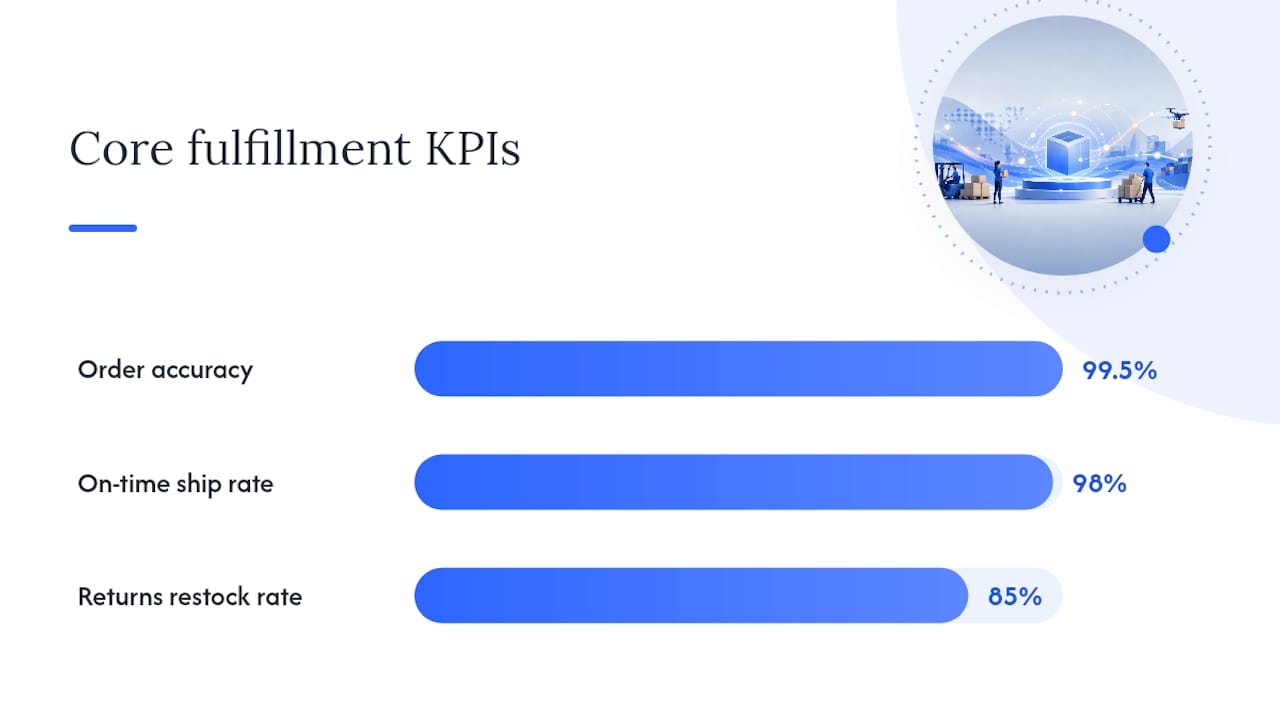
- Order accuracy: 99.5% or higher.
- On-time ship rate: 98% or higher.
- Inbound receiving time: 1 to 2 business days from dock to available inventory.
- Returns restock rate: 85% or higher back into sellable inventory.
- Cost per order, tracked monthly against your landed cost model.
One practical step brands skip: connect the 3PL’s billing feed to your general ledger codes before the first invoice arrives. Reconciling fulfillment costs after the fact, line by line, wastes hours your bookkeeper doesn’t have.
Why Envio3pl Builds Fulfillment Around SKU Profitability
Most 3PLs hand you an invoice. Envio3pl hands you a profitability breakdown by SKU, so you can see which products earn their shelf space and which ones are quietly costing you money in storage fees. That transparency, paired with a live inventory portal, same-day shipping cutoff at 1PM CST, and Amazon and Walmart prep built for retail spec, is what an operations-first fulfillment partner should look like for a brand that’s outgrown DIY logistics.
— Reddog
Get a Line-Item Quote and See the Envio3pl WMS in Action
Envio3pl skips the vague monthly invoice most 3PLs hand you and instead gives you SKU-level profitability data alongside your fulfillment costs, so you know exactly which products are worth the shelf space they take up.
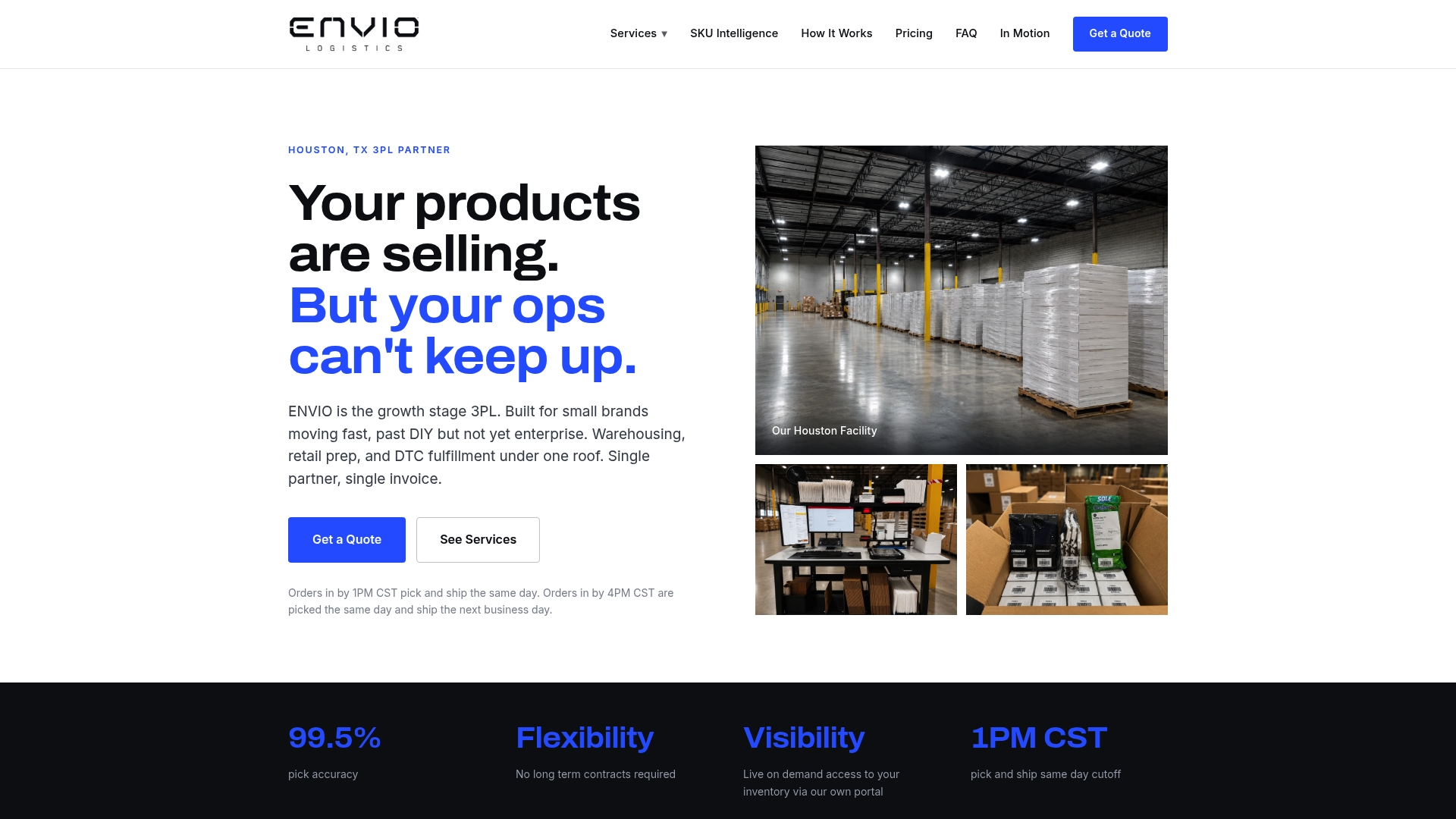
That transparency starts with a live inventory portal you can check anytime, not a weekly email update, plus same-day shipping for orders placed by 1PM CST and dedicated Amazon and Walmart prep for brands selling on marketplaces. There’s no long-term contract locking you in while you test whether the fit is right.
If you’ve run through the evaluation scorecard above, put Envio3pl through the same test. Request a line-item rate card and a live WMS walkthrough to see receiving, storage, and pick-pack costs broken out clearly, then compare the numbers against what you’re paying today.
Sources
- How to Build a 3PL Selection and Onboarding Process That Scales in 2026
- How to Build a 3PL Selection Framework That Scales Past $10M
- What Is a 3PL? An Honest Guide for Ecommerce Brands
0 comments