
FEFO ships the nearest-to-expire units first; FIFO ships the oldest-received units first. Use FEFO for expiry-dated stock and FIFO for non-expiry stock, and run both rules per SKU when your catalog mixes the two. FEFO only works if you’re capturing batch numbers and expiry dates at receiving, so don’t turn it on before your data can support it.
TL;DR:
- Using FEFO reduces spoilage and improves customer satisfaction by ensuring products with the shortest remaining shelf life are shipped first, especially in regulated industries.
- FEFO requires detailed lot and expiry date tracking at receiving, which increases operational complexity and system requirements compared to FIFO.
- Implementing FEFO effectively depends on accurate data capture at the dock, proper warehouse system configuration, and visual shelf layout to distinguish oldest-expiring stock.
- Many warehouses default to FIFO for simplicity, but switching to FEFO is advisable when handling perishables, requiring pilot testing before full deployment.
- Running both FIFO and FEFO simultaneously in a warehouse is possible with modern WMS systems that support per-SKU rotation flags, allowing flexible management of mixed catalog types.
Table of Contents
- FIFO vs FEFO: Definitions and Where the Confusion Starts
- Key Differences Between FIFO and FEFO and What They Cost You
- When to Use FIFO, FEFO, or Both
- Implementation Steps: Receiving, Labeling, and WMS Setup
- How a 3PL Enforces Rotation Rules at Scale
- Why Most Teams Overthink This Decision
- Sources
- FAQ
FIFO vs FEFO: Definitions and Where the Confusion Starts
FIFO stands for “first in, first out.” In a warehouse, it means the oldest-received units ship before newer arrivals. But FIFO also shows up as an accounting method, where it’s an assumption about which cost layer gets expensed first, not a rule about physical picking. Mixing up the two is one of the most common errors in inventory conversations, and it’s worth separating cleanly: FIFO is used both as a picking convention and an accounting assumption, and conflating them leads teams to build the wrong warehouse process around a financial reporting rule.
FEFO stands for “first expired, first out.” FEFO is a picking rotation method that prioritizes items by expiry date, so a batch expiring next week ships before a batch expiring next year, regardless of which one arrived at your dock first.
LIFO, “last in, first out,” is purely an accounting choice tied to cost reporting and tax treatment. Companies sometimes switch to or away from LIFO for tax reasons during inflationary periods, but LIFO has no place as a physical picking rule in a warehouse. Nobody should be shipping the newest apparel or the newest skincare batch first just because their books use LIFO.
A few quick examples clarify scope:
- Apparel and hard goods: no expiry date, so FIFO picking makes sense and keeps aging stock moving.
- Yogurt, produce, and other perishables: hard expiry dates demand FEFO, or you’ll write off product that FIFO would have shipped too late.
- Serums, supplements, and cosmetics: shelf life matters even without spoilage risk. Customers notice a jar with three months of shelf life left versus one with eighteen.
Key Differences Between FIFO and FEFO and What They Cost You
The core distinction is what triggers the pick. FIFO logic runs on receipt date: whatever hit your dock first goes out first. FEFO logic runs on expiry date, which means your system needs to know that date at the unit or batch level, not just the SKU level. That’s a meaningfully different data requirement, and it changes what your warehouse management system has to track.
| FIFO | FEFO | |
|---|---|---|
| Picking rule | Receipt date | Expiry date |
| Data needed | Receiving timestamp | Lot number, expiry date, remaining shelf life |
| System complexity | Low to moderate | Moderate to high (requires batch tracking) |
| Best for | Apparel, hardware, non-perishable goods | Food, pharma, cosmetics, supplements |
| Common failure mode | Aging stock sits too long, ties up capital | Newer short-dated batches expire before older long-dated ones ship |
The failure modes cut in opposite directions. Run FIFO on a perishable catalog and you can end up shipping a batch with 90 days of shelf life left while a batch with 10 days left sits behind it on the shelf, simply because it arrived later. That batch expires in your warehouse. Watch for two signals here: rising spoilage percentage on dated SKUs, and returns or complaints citing short remaining shelf life on delivery. Both point to a FIFO process running on a catalog that needed FEFO.
Statistic callout: Using FEFO on perishable catalogs reduces spoilage and write-offs and improves customer experience by ensuring the product a customer receives has more usable life ahead of it. That last point matters more than it sounds. Marketplaces increasingly enforce minimum remaining shelf-life policies on receipt, and a customer who opens a box to find a product expiring in two weeks tends to file a complaint or return, whether or not the product is technically still good.
Labor and system complexity rise with FEFO, too. FIFO can run on receiving timestamps alone. FEFO needs lot capture, expiry-date entry, and a WMS that can sort by that field instead of (or in addition to) receipt order, which usually means more receiving discipline and a system upgrade most spreadsheet-based operations don’t have yet.
When to Use FIFO, FEFO, or Both
Three rules of thumb cover most catalogs:
- If a SKU has an expiry date, use FEFO. Food, beverages, supplements, cosmetics with stated shelf life, and anything pharma or medical falls here. Regulated industries commonly require expiry-date rotation and documented traceability as a matter of compliance, not preference.
- If a SKU has no expiry date, use FIFO. Apparel, electronics, hardware, and most durable goods age in value, not in safety, so receipt-order rotation is enough.
- If your catalog mixes both, apply the rule per SKU. Most modern WMS platforms let you flag rotation logic at the SKU or category level, so a single warehouse can run FEFO on your skincare line and FIFO on your apparel line without conflict.
Three threshold tests tell you when it’s time to move a SKU from FIFO to FEFO: rising spoilage or write-off rates on that SKU, batch-to-batch variability in shelf life (some suppliers ship with wildly different remaining dates), and marketplace shelf-life minimums that reject shipments below a certain remaining percentage.
To classify your catalog: tag every SKU with an expiry flag, set per-SKU rotation rules in your WMS, then pilot the change on your highest-risk category before rolling it out warehouse-wide. Measure spoilage rate and return rate for 30 to 60 days before and after.
Pro Tip: Don’t flip your entire warehouse to FEFO overnight. Pilot it on one perishable category, confirm your receiving team is actually capturing lot and expiry data consistently, then expand. A rotation rule your team can’t execute accurately is worse than the simpler rule it replaced.
Implementation Steps: Receiving, Labeling, and WMS Setup
Getting FEFO or FIFO to actually run correctly on the floor comes down to four operational layers.
Receiving: Capture lot number, expiry date, and remaining shelf life at the dock, every time. FEFO requires batch and lot capture at receiving, and without that data your WMS has nothing to sort by, no matter how sophisticated the software is. Set a minimum remaining shelf-life threshold for accepting deliveries, and reject or renegotiate anything below it before it ever hits a shelf.
WMS configuration: Enable lot and batch tracking, pick-by-batch instructions, and per-SKU rotation flags so FEFO and FIFO can coexist in the same facility. Expiry-horizon alerts, which flag batches approaching their cutoff, catch problems before they become write-offs rather than after.
- Enable lot/batch tracking at the SKU level, not just the category level.
- Set rotation flags per SKU so mixed catalogs don’t force an all-or-nothing choice.
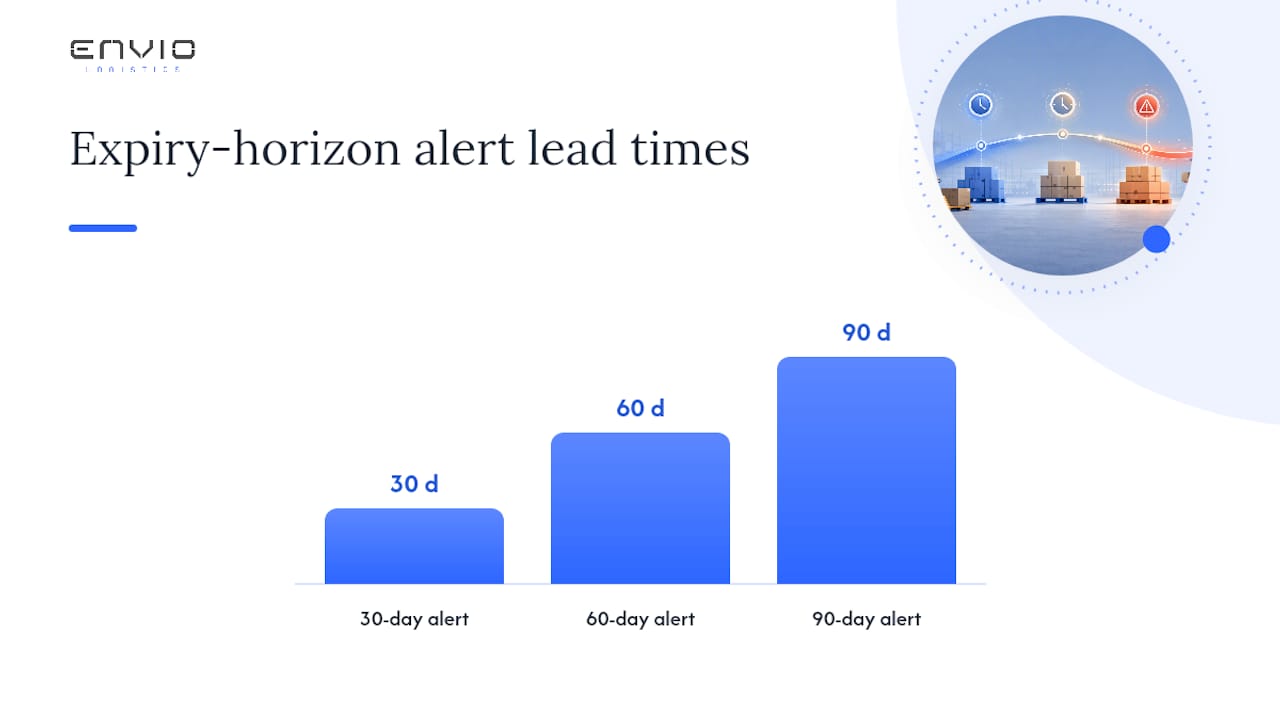
- Configure expiry-horizon alerts to fire 30, 60, and 90 days out.
- Build an exception workflow for damaged or mislabeled dates caught at receiving.
Physical layout: Bin labeling and shelf layout should make FEFO visually obvious, oldest-expiring stock front-facing and easy to grab, so pickers aren’t relying purely on system prompts.
Reporting: Run an expiry-horizon report on a fixed cadence, weekly for fast-moving perishables, and build a clear returns process for dated goods that come back close to their cutoff.
Statistic callout: A closed-loop system that captures lot number, expiry date, and unit cost at the moment of receipt turns FEFO picking and FIFO accounting into something software handles automatically, instead of something a receiving clerk has to remember correctly every single time.
How a 3PL Enforces Rotation Rules at Scale
Most warehouses default to FIFO because it’s intuitive. FEFO becomes necessary once a catalog includes perishable or regulated SKUs, and it’s more achievable for small and mid-sized operations now than it used to be, given how far cloud-based warehouse systems have come.
This is where outsourcing the physical execution changes the equation. Envio Logistics, Inc runs live inventory data that lets brands see batch-level stock status in real time, not after a monthly reconciliation. Combined with SKU profitability analysis, that visibility helps brands catch a SKU that’s generating write-offs under the wrong rotation rule before it erodes margin quietly for months.
- Live inventory access shows expiry-horizon risk as it develops, not after a write-off.
- SKU profitability analysis flags which dated SKUs are losing money to spoilage.
- Same-day shipping for orders placed by a mid-day cutoff keeps FEFO-picked stock moving before its window closes.
- No long-term contracts means you can test a rotation strategy without locking into it for years.
Why Most Teams Overthink This Decision
The FIFO versus FEFO debate gets treated like a philosophical choice when it’s really a data-readiness question. Your catalog tells you which rule you need. Expiry dates mean FEFO. No expiry dates mean FIFO stays fine. The actual failure point isn’t picking the wrong philosophy; it’s running FEFO on paper while your receiving team never actually captures lot numbers or expiry dates, so the system defaults back to receipt order anyway.
Conventional advice treats this as a binary, pick one method for your whole warehouse. That’s backwards for most mixed catalogs. A brand selling both apparel and skincare doesn’t need a single warehouse-wide rule; it needs per-SKU flags and a WMS that can hold both logics at once. Where most operators go wrong isn’t the framework. It’s skipping the pilot phase and rolling FEFO out across an entire perishable line before confirming receiving discipline can actually support it.
Prioritize the boring part first: get lot and expiry capture right at the dock before you touch a single WMS setting. Everything downstream depends on that data existing and being accurate.
— Claudio Saenz
Sources
For readers who want the underlying frameworks: ISO publishes management-system standards relevant to traceability and quality control. Regulated-goods operators should review GMP/GDP guidance on FIFO, FEFO, and LIFO, and fleet or regulated-storage operations may find the ISO 22241 compliance checklist useful for expiry-tracking requirements.
- FIFO, FEFO, and LIFO Inventory Methods
FAQ
What is the difference between FIFO, FEFO, and LIFO?
FIFO ships the oldest-received stock first, FEFO ships the nearest-to-expire stock first, and LIFO is an accounting method for cost reporting, not a physical picking rule at all.
What is LIFO in food inventory?
LIFO rarely applies to food picking because it would ship the newest stock first and leave older, closer-to-expiry product sitting on the shelf. Food operations almost always need FEFO instead.
Is it better to use FIFO or LIFO?
For physical warehouse rotation, FIFO is almost always the better default over LIFO, since LIFO as a picking method risks stranding older stock until it spoils or becomes obsolete. LIFO’s real use is in accounting, where it’s chosen for tax and cost-reporting reasons unrelated to shipping order.
How can I tell if my company is using FIFO or LIFO?
Check your receiving and picking process: if the oldest-received units ship first, that’s FIFO. If your accounting reports assume the most recently purchased inventory is sold first for cost purposes, that’s a LIFO accounting method, which can run independently of your actual picking logic.
Can FIFO and FEFO run in the same warehouse?
Yes. Most modern WMS platforms support per-SKU rotation flags, so you can run FEFO on expiry-dated categories and FIFO on everything else in the same facility without conflict.
0 comments