
Floor loading wins when your goal is maximizing units per container and your destination crew can absorb the labor. Palletized loading wins when speed, damage control, and receiver requirements matter more than cube. Floor loading typically packs 15 to 25 percent more product by volume, but it costs more to unload and takes longer at the dock. The numbers below let you run that trade-off against your own SKUs.
TL;DR:
- Floor loading can pack up to 25 percent more product in a container but requires longer unloading times and more labor at the destination dock.
- While floor loaded shipments increase cargo volume, their devanning costs are roughly two to three times higher than palletized loads, which can reduce overall savings.
- Confirm your receiving dock has adequate forklift availability, proper labeling, and capacity to handle floor-loaded freight before choosing this method.
- Using a hybrid approach—floor loading for ocean transit and palletizing near the destination—can optimize cube efficiency while minimizing dock chaos.
- Running detailed cost analyses, including devanning, labor, and detention fees, is essential to determine if the cube savings outweigh the handling expenses.
Table of Contents
- Floor Loaded vs Palletized: What Each Method Actually Means
- Floor Loading vs Palletizing: A Side-by-Side Look
- What Devanning Actually Costs in 2026
- Can Your Receiving Dock Actually Handle a Floor-Loaded Container?
- Hybrid Loading: Getting the Cube Without the Dock Chaos
- A Practitioner’s Note on Making the Call
- Let Envio Handle the Devanning, Pallets, and Prep
- Sources
- FAQ
Floor Loaded vs Palletized: What Each Method Actually Means
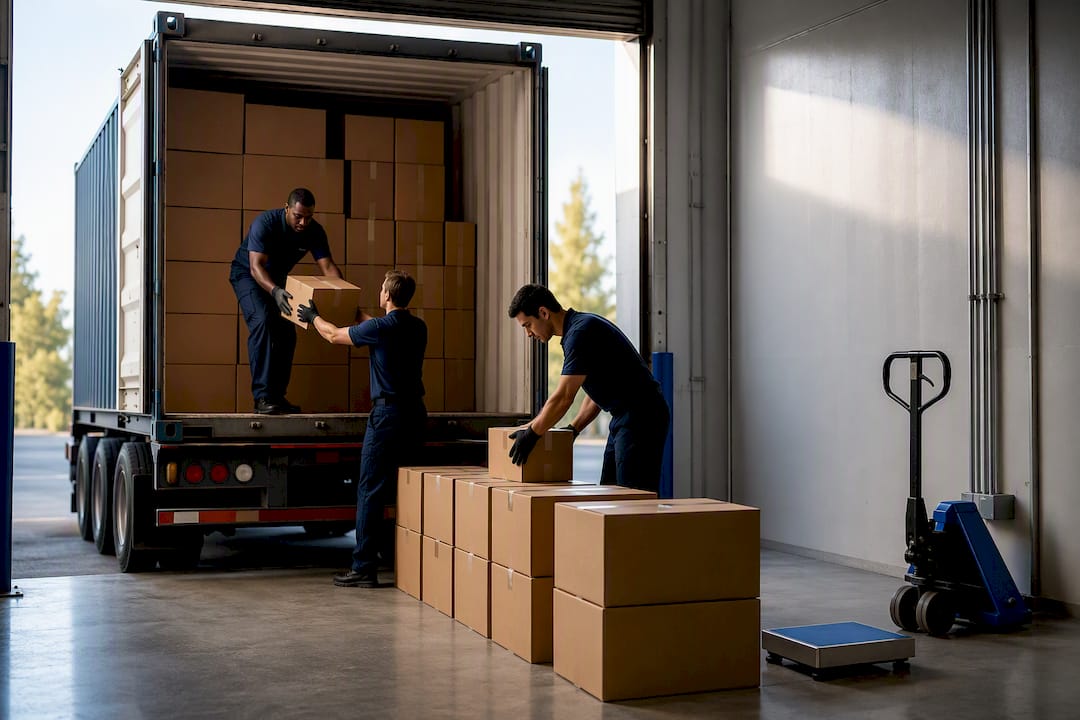
Floor loading means cartons get hand-stacked directly onto the container or trailer floor, packed edge to edge and often stacked ceiling-high with no pallets underneath. There’s no wasted airspace around pallet decks, which is exactly why it moves more cargo per container. The trade-off shows up at the other end: every carton comes off by hand.
Palletized loading, sometimes called unitized loading, means cartons are stacked and secured onto pallets before they go into the container. The industry standard in North America is the GMA pallet at 48 by 40 inches, and warehouse teams describe stacking configurations using “ti-hi,” shorthand for tiers high (layers) by how many units sit on each tier. A forklift moves a whole pallet in one motion instead of a worker moving one box at a time.
Devanning is the term for unloading a container, and it plays out differently depending on the method:
- Floor-loaded devanning requires a crew to pull cartons by hand, often building pallets on the spot as they go.
- Palletized devanning lets a single forklift operator pull pre-built pallets straight off the container and into a receiving lane.
- Either way, the goal at the warehouse is the same: get inventory scanned, put away, and available for pallet storage or outbound prep as fast as possible.
Floor Loading vs Palletizing: A Side-by-Side Look
Your decision usually comes down to five operational axes, and they rarely all favor the same method.
- Space utilization: Floor loading fits 15 to 25 percent more cube because pallets themselves take up height and floor space that would otherwise hold product. A 40-foot container that holds 2,000 cartons floor-loaded might hold only 1,600 to 1,700 palletized.
- Loading and unloading time: A floor-loaded 40-foot container commonly takes 2 to 5 hours to unload with a small crew, while a palletized container comes off in 30 to 45 minutes with one forklift operator.
- Labor requirement and cost: Floor loading needs multiple warehouse workers on the clock for hours. Palletized loads need one skilled forklift operator for a fraction of that time, which is the single biggest cost lever in this comparison.
- Damage risk and cargo protection: Hand-stacked cartons can shift during transit and take on crush damage from stacking weight, especially near the bottom of a floor-loaded stack. Unitized loads distribute weight more evenly and travel as a secured block, which generally lowers breakage.
Detention and demurrage exposure tracks directly with unloading speed. A carrier that has to wait five hours for a floor-loaded container to clear the dock is far more likely to trigger detention charges than one that clears in under an hour. If your receiving dock runs on tight appointment windows, slow devanning becomes a hidden cost that never shows up on the freight invoice.
What Devanning Actually Costs in 2026
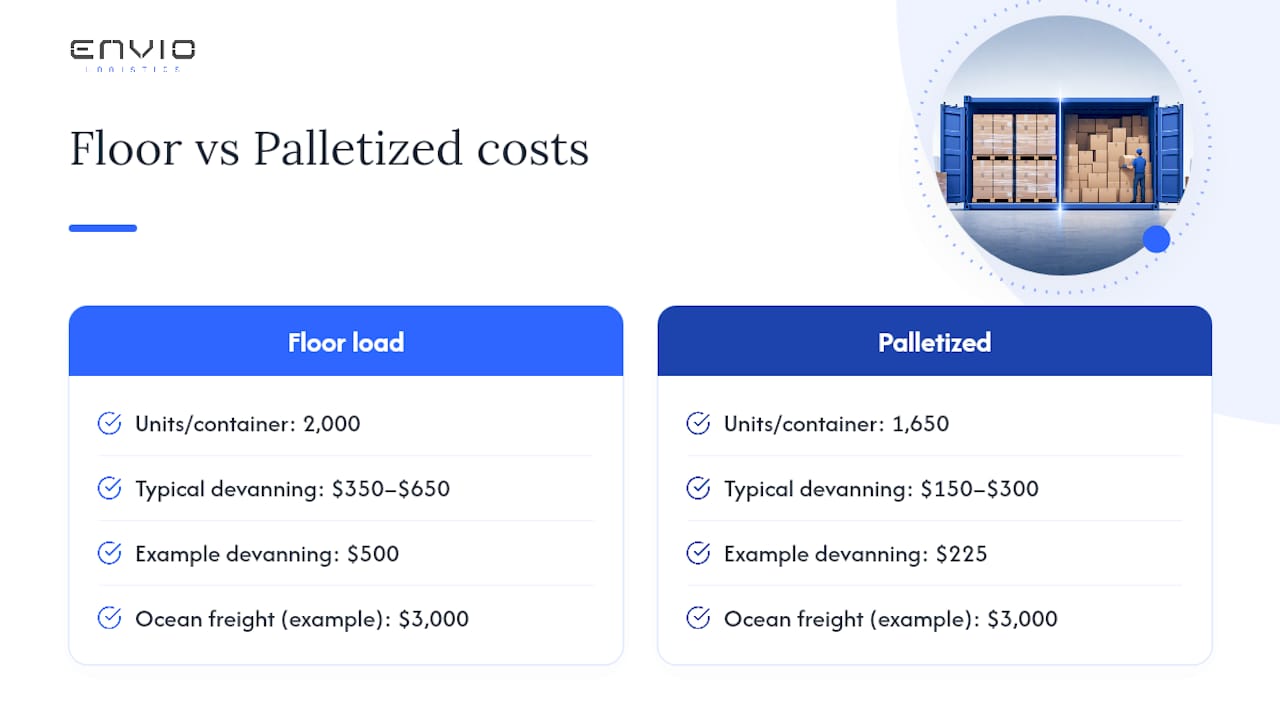
Run the math before you commit to a loading method, because the ocean freight savings from floor loading can evaporate at destination if you don’t account for devanning.
Devanning a floor-loaded 40-foot container typically runs $350 to $650, while a palletized container in the same size class typically runs $150 to $300. All-in port-to-warehouse costs, including drayage, pallet materials, and handling, commonly land between $800 and $1,500 per container once everything is factored in. Some providers quote devanning per carton instead of per container, which can look cheaper on paper until heavy-case adders, SKU sorting fees, or palletize-out material charges get added on top.
Statistic Callout: Floor-loaded devanning costs roughly two to three times more than palletized devanning per container, but a floor-loaded container can carry up to 25 percent more product. Whether that trade pays off depends on your per-unit freight rate and how much destination labor actually costs in your market.
Here’s a simplified way to test it. Say your ocean freight rate is $3,000 per 40-foot container. Floor-loaded, you fit 2,000 units; palletized, you fit 1,650 units at the same freight rate. That’s $1.50 per unit floor-loaded versus $1.82 per unit palletized on freight alone. Now add devanning: $500 floor-loaded and $225 palletized. Floor-loaded total per-unit cost comes to $1.75; palletized comes to $1.96. Floor loading still wins here, but the gap narrows fast, and it flips entirely if your destination labor rates run high or your receiver charges a rework fee for hand-stacked freight.
Can Your Receiving Dock Actually Handle a Floor-Loaded Container?
Cube savings mean nothing if your receiving network can’t process the freight without triggering penalties. Confirm these before you commit to floor loading:
- Forklift and labor availability: Palletized freight needs one operator; floor-loaded freight needs a crew, sometimes hired as day labor or “lumpers” specifically for the unload.
- Dock door throughput and free time: Slower devanning eats into carrier free time, and detention fees start accruing once that window closes.
- Receiver format requirements: Retail distribution centers, Amazon FBA, and Walmart WFS programs generally expect palletized freight with specific labeling and pallet configurations, not floor-loaded cartons.
- Overweight and rework risk: Undeclared heavy cases or inaccurate carton counts lead to receiver rejection or surprise rework fees at the dock.
OSHA’s guidance on loading docks and powered industrial trucks covers the staffing, equipment, and safe-handling standards that shape whether a facility can even accept floor-loaded freight without adding risk. A dock with no forklift certification program or no dedicated staging area for hand-unloaded cartons is not set up for floor loading, no matter how good the cube math looks on paper.
The fix is simple: declare accurate carton counts and case weights before the container ships, and confirm receiver labor capacity in writing. That single step avoids most of the detention and rejection scenarios that turn a cheap floor-loaded shipment into an expensive one.
Hybrid Loading: Getting the Cube Without the Dock Chaos
You don’t have to pick one method for every shipment. Many shippers floor-load the ocean leg, where freight rates reward cube efficiency, then palletize at a cross-dock facility near the final destination. That approach captures the cube benefit on the expensive leg while still delivering forklift-ready pallets to a receiver that requires them.
A few practices make floor loading safer and cheaper when you do use it:
- Stack heavier cartons on the bottom and lighter ones on top to reduce crush damage.
- Use dunnage and load bars to stop cartons from shifting during transit.
- Choose cartons with adequate stacking strength for floor-to-ceiling loads, not just single-layer shipping.
- Get an all-in devanning quote up front, not a per-carton rate that hides adders.
Pro Tip: Always ask your devanning provider for a single all-in number that covers unloading, sorting, and palletize-out materials. A “per carton” quote that looks cheap on the surface often balloons once heavy-case and SKU-sort fees get tacked on. Packaging partners like PackLogica can also help you rework carton specs before you ship, which matters more for floor-loaded freight than palletized freight since there’s no pallet deck absorbing shock.
A Practitioner’s Note on Making the Call
Most bad loading decisions come from skipping one step: checking whether the destination crew can actually handle what you’re about to ship them. We’ve watched floor-loaded containers sit at a dock for six hours because nobody confirmed forklift and labor availability ahead of time, turning a cube win into a detention bill.
Running container devanning and palletizing for a wide range of consumer brands has taught us that the SKU-level math matters more than any blanket rule. Before you route a container, run three checks: multiply carton count by average case weight, request an all-in devanning quote instead of a per-carton rate, and confirm a labor crew is reserved if you’re floor loading. Skip any one of those and the freight savings disappear at the dock.
— Claudio Saenz
Let Envio Handle the Devanning, Pallets, and Prep
Whichever method wins your ROI math, someone still has to unload it, palletize it, and get it dock-ready without blowing your timeline. That’s the part most brands underestimate. Envio Logistics, Inc runs container devanning for both 20ft and 40ft loads, palletizing with wrap, and cross-dock turnarounds up to 30 days, so you get the cube savings from floor loading without staffing a crew yourself.

Orders placed by 1PM CST may in some cases ship the same day, and some providers offer live inventory visibility rather than weekly reporting to show what is actually on your shelves. SKU profitability analysis can help flag which products are worth palletizing costs and which ones may be reducing margins due to handling fees. If you’re prepping for Amazon or Walmart, our retailer prep services handle the spec compliance so your pallets don’t get rejected at the receiving dock.
Some logistics providers offer all-in devanning quotes based on carton count, case weights, and container size to help determine landed costs before shipment.
Sources
- Warehousingcosts
- The Effect of Pallets and Unitization on the Efficiency of Intercontinental Product Movement Using Ocean Freight Containers (VT thesis)
- OSHA eTools: Loading docks (powered industrial trucks)
- Shipping container pallets (PalletOne)
- Floor-Loaded vs. Palletized Freight: Cost and Trade-Offs (DerbyLogistics)
FAQ
What Does Floor Load Mean in Shipping?
Floor loading means cartons are hand-stacked directly onto the container or trailer floor without pallets, often stacked floor to ceiling. It’s the loading method that maximizes cube utilization but requires manual labor to unload.
What Is a Palletized Load?
A palletized load is cargo that’s been stacked and secured on pallets, typically the 48 by 40 inch GMA pallet standard in North America, before being loaded into a container or trailer. Forklifts move palletized freight in and out far faster than hand-stacked cartons.
What Does It Mean if a Shipment Is Palletized?
It means the freight arrives on pallets rather than as loose, hand-stacked cartons, which lets a receiver unload it with a forklift instead of a labor crew. Many retail distribution centers and Amazon FBA programs require palletized freight specifically because it’s faster and safer to process at scale.
How Many Pallets Is a Full Load?
A standard 53-foot dry van typically holds multiple pallets, while a 40-foot ocean container usually holds about 20 pallets depending on stacking height and product density. The exact count depends on pallet dimensions, product weight limits, and how the cargo is stacked (single versus double layer).
Is Floor Loading Cheaper Than Palletizing?
Floor loading usually costs less on freight per unit because it fits more product per container, but it costs more to unload. Devanning a floor-loaded 40-foot container runs $350 to $650 compared to $150 to $300 for a palletized container, so the real savings depend on your destination labor costs.
0 comments