
Live inventory tracking is a system that updates your stock count the moment something happens, a sale, a return, a shipment, so what your screen shows always matches what’s on the shelf. The payoff is simple: you stop overselling, you catch stockouts before they cost you a customer, and you fulfill orders faster. If you’re still running counts on a spreadsheet, the next move is an honest audit of where your data lags and which integration to fix first.
TL;DR:
- Live inventory tracking updates stock in real-time through event-driven systems, reducing overselling and stockouts compared to batch models.
- Key metrics to monitor include achieving at least a 98% inventory accuracy rate and maintaining low stockout and order-to-ship cycle times.
- Technology options range from barcode scanners and RFID tags to IoT sensors, with small operations often preferring simpler, low-cost capture tools.
- Scaling live tracking requires robust data architecture, including streaming platforms and optimized database reads, to handle increasing SKUs and locations.
- Managed services like Envio offer ready-made live inventory portals and fulfillment support, eliminating the complexity of building in-house systems.
Table of Contents
- What Live Inventory Tracking Actually Means
- What Do You Gain From Real-Time Inventory Visibility?
- Which Technologies Actually Power Live Tracking?
- How Do You Roll Out Live Inventory Tracking?
- What Goes Wrong, and How Do You Fix It?
- How Envio Supports Live Inventory Visibility for Growing Brands
- Security and Privacy Considerations for Live Inventory Data
- Scaling Live Tracking as Your Business Grows
- What Do Real Deployments Look Like?
- Where Is Live Inventory Tracking Headed?
- A Straight Take on Rollout Priorities
- Skip the DIY Integration Headache With Envio
- Sources
- FAQ
What Live Inventory Tracking Actually Means
Live inventory tracking runs on events, not schedules. Every sale, receipt, or transfer fires an event that updates one authoritative inventory record in real time. That record is the single source of truth every other system reads from, your storefront, your warehouse app, your customer service dashboard.
Compare that to batch or periodic tracking, where someone exports numbers at the end of the day or runs a nightly sync. In that model, your “current” stock count is really yesterday’s count with guesswork layered on top.
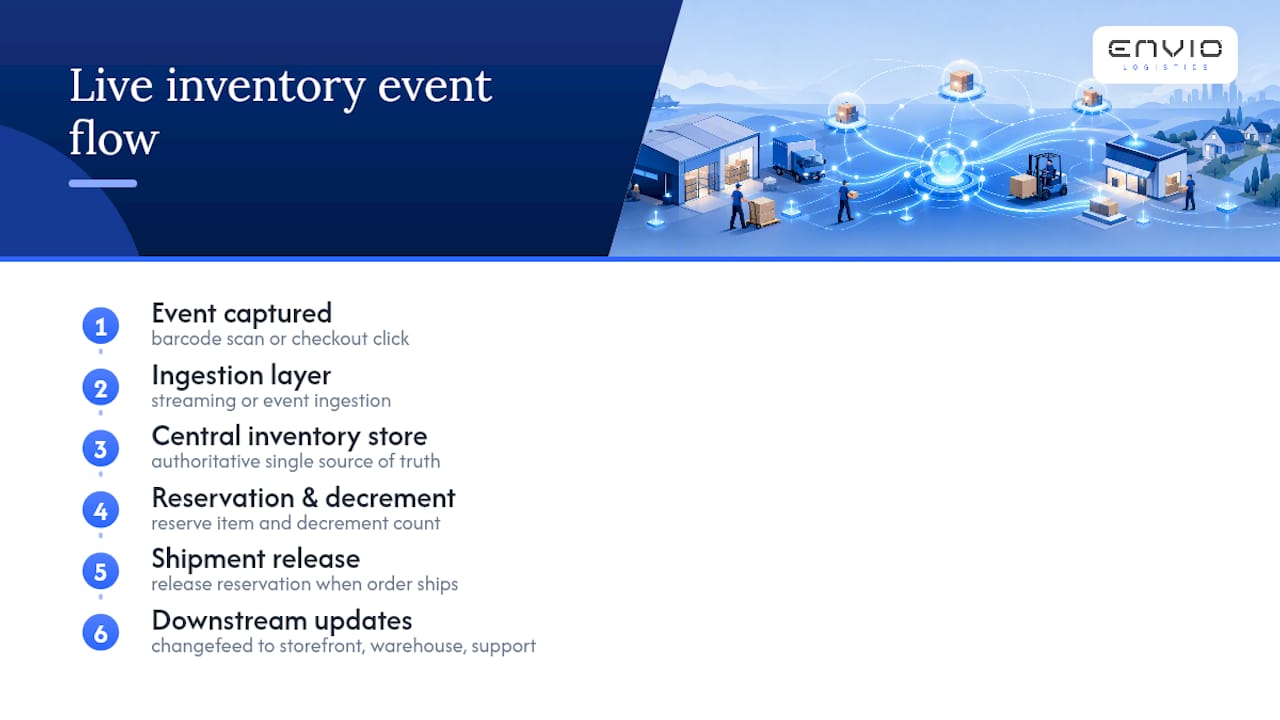
The architecture behind live tracking follows a clear path: an event is captured (a barcode scan, a checkout click), it moves through an ingestion or streaming layer, and it lands in the central inventory store, which then pushes updates downstream through a changefeed or event stream. A real example: a customer buys the last unit of a SKU, the system creates a reservation, decrements the count, and releases the reservation once the order ships. If the reservation never fires, you sell a product you don’t have. That’s the event-driven model that separates real-time systems from everything else.
What Do You Gain From Real-Time Inventory Visibility?
The business case comes down to four measurable outcomes: fewer oversells, fewer stockouts, faster order-to-ship times, and forecasting that reflects what’s actually happening on your shelves. Cloud-based inventory platforms with integrated POS and ERP connections cut manual counts and reconciliation work dramatically for small operators, according to Xero’s inventory management research.
Track these KPIs once you go live:
- Inventory accuracy rate — target 98% or higher; anything lower signals a data gap somewhere in your pipeline.
- Stockout rate — how often a listed SKU is actually unavailable at checkout.
- Order-to-ship cycle time — the gap between order placement and shipment.
- Carrying cost reduction — savings from not overstocking “just in case.”
Pro Tip: Run your accuracy rate weekly for the first two months. A number that swings more than a few points week to week usually points to a specific integration, not a system-wide failure.
The math on manual counts alone often justifies the switch: fewer cycle counts, fewer canceled orders from overselling, and less staff time spent reconciling numbers that were already wrong by the time anyone looked at them.
Which Technologies Actually Power Live Tracking?
Most SMBs build live tracking from a mix of capture tools, a data backbone, and integration layers, not a single piece of software. The right combination depends on your budget and your accuracy requirements.
On the capture side, you’ve got options at every price point:
- Barcode or QR scanning via smartphone apps, the cheapest entry point for most small operations.
- Dedicated handheld scanners, faster and more durable for high-volume picking.
- RFID tags, useful when you need bulk reads without line-of-sight scanning.
- IoT sensors, for weight-based or motion-triggered stock detection.
Real-time location systems (RTLS) add a layer on top, tracking exactly where inventory sits inside a facility. The benefits are real: less time spent searching for misplaced stock and better flow optimization across the floor. But cost and installation effort are the sticking point for smaller operations, and survey data on RTLS adoption shows roughly 81% of practitioners view real-time tracking as important, yet about 56% only feel comfortable committing when upfront investment stays under $10,000.
On the platform side, you need an inventory core acting as your single source of truth, a WMS or ERP connected to it, and either an event bus like Kafka or AWS Kinesis, or something simpler like webhooks, moving data between them. Pro Tip: If your SKU count is under a few thousand and you’re running one or two sales channels, skip the event bus entirely. A well-configured webhook setup between your storefront and inventory system will handle the load without the engineering overhead.
How Do You Roll Out Live Inventory Tracking?
Start narrow. Trying to instrument every SKU and every location on day one is how rollouts stall for months.
- Define success metrics and scope. Pick your target accuracy rate and choose a handful of SKUs or one location to pilot first.
- Audit your current process. Map every point where stock changes hands, receiving, picking, shipping, returns, and flag where your data currently breaks down.
- Choose your tracking model. Decide whether your ERP will act as the system of record or whether you’ll run a dedicated inventory service that other systems read from.
- Pick capture technology for the pilot. Match the tool to the SKUs involved, barcode scanning for general merchandise, RFID if you’re tracking bulk or high-turnover items.
- Map your integrations. List exactly which systems need write access (POS, WMS, ecommerce platform) and which only need read access, then decide between full event-driven sync or a short-delta sync running every few minutes.
- Test real scenarios before full launch. Run through checkout reservations, multi-warehouse order splitting, and returns processing specifically, these are where most systems fail first.
Once live, put operational guardrails in place:
- Idempotency checks so a duplicate event doesn’t double-decrement stock.
- Small stock buffers on fast-moving SKUs to absorb sync delays.
- Dead-letter queues that catch failed events instead of silently dropping them.
- Alerts tied to a specific owner, not a general inbox nobody checks.
What Goes Wrong, and How Do You Fix It?
Most live tracking failures aren’t dramatic system crashes. They’re small timing and workflow gaps that compound.
Latency causing overselling. If your system takes even a few seconds to register a sale, two customers can buy the same last unit. Checkout reservations that hold stock the moment an order starts, combined with a small buffer on your fastest-moving SKUs, close that window.
Conflicting writes. When two systems try to update the same SKU at once, optimistic concurrency control (checking a version number before committing a White) prevents one update from silently overwriting another.
Integration gaps. A dropped API call or a schema change can quietly break your sync. Retries, dead-letter queues, and monitoring that flags silence (not just errors) catch this before it becomes a stockout.
Human workflow lag. Technology doesn’t fix a warehouse employee who scans items at the end of their shift instead of in real time. As Kissflow’s research on retail visibility points out, visibility depends on workflows that route detection straight to action.
Pro Tip: Make scanning the path of least resistance. If it’s faster for staff to skip the scanner than use it, they will, no matter how good your system is.

How Envio Supports Live Inventory Visibility for Growing Brands
Not every brand wants to own this build. A managed 3PL model hands you live inventory data without the integration work, no event bus to configure, no schema contracts to maintain. Certain 3PL providers offer clients a live inventory portal, SKU profitability analysis to flag which products are worth scaling, and same-day shipping for orders placed by a specific cutoff time.
When evaluating any 3PL partner for this, require portal or API access to your own data, clear reporting, integration support for your existing sales channels, and defined service levels, not vague promises. DIY suits brands with in-house technical resources; a managed approach fits brands that would rather spend that time on product and marketing.
Security and Privacy Considerations for Live Inventory Data
Live inventory systems handle more than stock counts. They often touch order data, customer shipping details, and, in multi-warehouse setups, information about multiple business partners moving through the same platform. That makes access control the first line of defense, not an afterthought.
Role-based permissions matter more in real-time systems than batch ones, because a compromised credential doesn’t just expose old data, it exposes a live feed of what’s happening right now. Limit write access to the specific systems that need it (your POS, your WMS) and keep read access separate from write access wherever possible.
API integrations deserve particular scrutiny. Every webhook or event stream connecting your inventory core to a third-party platform is a potential entry point, so use authenticated, encrypted connections (HTTPS, signed webhook payloads) rather than open endpoints. Rotate API keys on a schedule instead of leaving the same credential active indefinitely.
Data retention policies need a second look once you’re capturing granular event-level data. A system logging every scan, every reservation, every decrement generates a detailed operational history fast. Decide upfront how long you retain raw event logs versus aggregated summaries, both for storage cost reasons and because unnecessary historical data is unnecessary risk if a breach occurs.
If you’re working with a third-party logistics provider or SaaS inventory platform, ask directly where your data is stored, who can access it, and whether it’s shared with any other party. A vendor unwilling to answer clearly is a signal worth taking seriously before you sign anything.
Scaling Live Tracking as Your Business Grows
A system that handles 500 SKUs across one warehouse can fall over completely at 5,000 SKUs across three. Performance problems in live inventory tracking rarely show up as outright failures, they show up as delay, a sync that used to take two seconds now takes twenty.
The first scaling lever is your data architecture. A single authoritative inventory record works well at small scale, but as event volume grows, the ingestion layer feeding that record needs to keep pace. This is exactly where a streaming platform like Kafka or AWS Kinesis earns its complexity: it buffers and processes events at high volume without losing the order they happened in, which matters when a rapid sequence of sales, returns, and transfers all touch the same SKU within seconds.
Database read patterns matter just as much as write speed. If every storefront page load queries your live inventory count directly, that read load scales with traffic, not with inventory changes. Caching frequently checked SKUs with short expiration windows keeps read pressure off your core system without sacrificing much accuracy.
Multi-location scaling adds another layer: routing logic that decides which warehouse fulfills which order needs its own inventory visibility, ideally querying aggregated stock across locations rather than hitting each warehouse’s system separately for every request.
The practical takeaway for a growing SMB: build with headroom, not for your current volume. A system that works cleanly at your current order count but requires a rebuild at double that volume is a cost you’re deferring, not avoiding.
What Do Real Deployments Look Like?
Small retailers running platform-native inventory systems, where POS, ecommerce, and stock tracking live in the same platform instead of being stitched together, see less reconciliation work and fewer fulfillment errors, according to Shopify’s research on real-time inventory management. The pattern holds across smaller operations too: unifying inventory inside the system that actually owns your orders, rather than syncing it across separate tools with middleware, closes the gaps that cause most oversells.
Manufacturers running multi-warehouse operations show a different pattern. Their biggest gains typically come not from faster scanning but from reservation logic that holds stock the instant an order starts, before payment even clears. That single change eliminates the specific failure mode where two channels sell the same unit within the same minute.
RTLS deployments inside distribution centers tell a more mixed story. The technology genuinely reduces search time and improves how staff move through a facility, but the RTLS adoption research shows smaller operators consistently choose lower-accuracy, lower-cost options over premium RTLS setups, trading some precision for a system they can actually afford to install and maintain. That trade-off is rational for most SMBs, not a compromise to feel bad about.
Where Is Live Inventory Tracking Headed?
Predictive inventory logic is moving from “nice to have” to standard practice. Instead of just reporting what’s in stock right now, systems increasingly flag what’s likely to run out based on recent velocity, seasonal patterns, and current reservations, giving teams a warning window instead of a reactive scramble.
Edge computing is changing where inventory logic actually runs. Rather than every scan traveling to a central server before an update registers, more systems process events locally at the warehouse or store level first, cutting the latency that causes overselling in the first place.
RFID and IoT sensor costs continue to drop, which slowly closes the affordability gap that’s kept RTLS out of reach for smaller operations. As that gap narrows, expect more SMBs to adopt partial RTLS coverage, tracking high-value or fast-moving SKUs with sensors while leaving lower-priority stock on simpler barcode workflows.
Unified commerce platforms are also consolidating what used to require three or four separate tools, POS, inventory, ecommerce, into single systems with inventory logic built in natively rather than bolted on through integrations. That shift favors smaller businesses specifically, since it removes the integration burden that’s historically made live tracking feel like an enterprise-only capability.
A Straight Take on Rollout Priorities
Most teams over-invest in capture technology and under-invest in integration mapping. The barcode scanner isn’t your bottleneck, your webhook between POS and inventory core probably is. Fix the data path first, then worry about hardware.
— Claudio Saenz
Skip the DIY Integration Headache With Envio
Envio Logistics, Inc is the alternative to piecing together your own inventory stack from separate vendors, one for warehousing, one for prep, one for fulfillment software, each with its own contract and its own blind spots. Instead, you get one system: warehousing and fulfillment with live inventory portal access built in, SKU profitability analysis that tells you which products deserve more shelf space, and same-day shipping for orders placed by 1PM CST.

There’s no long-term contract locking you in while you figure out if the fit is right. If you’re prepping for Amazon or Walmart specifically, Envio’s prep services handle spec compliance without adding another vendor to your list. Check current services and pricing and send over your SKU count to get a quote.
Sources
For deeper technical detail, review the RTLS adoption research and the event-driven architecture guide referenced throughout this piece.
- Real Time Inventory Management System Guide (2026) | Technioz
- Inventory management system guide (Xero) — 2026
- Why real-time inventory visibility is so hard in retail | Kissflow
FAQ
What Is the Best Program to Track Inventory?
There’s no single best program. It depends on your SKU count and channels: cloud platforms like Xero’s inventory tools work well for small catalogs, while growing brands often get more value from a managed 3PL with a built-in live inventory portal.
Can I Use My Phone as an Inventory Scanner?
Yes. Most modern inventory apps support barcode and QR scanning through a smartphone camera, making it a low-cost entry point before investing in dedicated handheld scanners.
Can I Use Excel to Track Inventory?
Excel works for very low SKU counts with infrequent updates, but it can’t support live tracking because it has no event capture or automatic sync with sales channels. Once you’re managing multiple locations or channels, batch spreadsheet updates create the exact accuracy gaps live tracking is meant to close.
What Is the Best App for Tracking Home Inventory?
For personal or small business use, any app with barcode scanning and cloud sync will handle basic tracking needs. Businesses selling across multiple channels typically outgrow consumer-grade apps quickly and need a system tied directly to their point of sale and warehouse operations.
Does Envio Logistics, Inc Provide Live Inventory Access?
Yes. Envio Logistics, Inc gives clients access to a live inventory portal alongside SKU profitability analysis, removing the need to build or maintain a separate real-time tracking system in-house.
0 comments