
Use signature-required shipping when you need verified proof of receipt, not just delivery confirmation. Choose Adult or Restricted Delivery for compliance goods, Direct signature for high-value proof, or Indirect for flexible residential confirmation. All three carry per-package surcharges, so pick the tier at label creation, and audit your carrier invoices monthly for fees you never actually earned.
TL;DR:
- Signature requirements must be purchased at the time of mailing for USPS and are strictly enforced at fulfillment to prevent delays or compliance issues.
- Carrier surcharges for signature tiers range around $7.15 to $10.00 per package, with many carriers auto-apply fees based on declared value or SKU type.
- Failed signature attempts can delay delivery by two to three days, especially for Adult Signature or direct tiers, making customer communication crucial.
- High-value, regulated, or age-restricted products should automatically trigger signature flags at the product catalog level to avoid fulfillment errors.
- Outsourcing fulfillment to a partner like Envio ensures signature rules are enforced at the SKU level and streamlines tracking and fee reconciliation.
Table of Contents
- What Is Signature Required Shipping and Which Tier Do You Need?
- How Do You Add Signature Required Shipping to a Label?
- What Happens If a Package Requires a Signature and No One’s Home?
- How Much Does Signature Confirmation Cost?
- Which Products Legally Require Adult or Restricted Delivery?
- How Do You Cut Failed Signature Deliveries?
- A Shipping Manager’s Short Checklist
- How Envio Helps You Manage Signature-Required Shipping
- Sources
- FAQ
What Is Signature Required Shipping and Which Tier Do You Need?
Signature required shipping means the carrier will not release a package until someone signs for it, either the named recipient, an adult at the address, or a specific age-verified person, depending on the tier you select. Each of the three major carriers builds its own version of this ladder, and the differences matter more than most shipping managers realize until a package gets stuck in redelivery limbo.
USPS offers Signature Confirmation, which requires a recipient or “responsible person” at the residence to sign, and it must be purchased at the time of mailing, not added after the fact. Adult Signature Required steps that up: the signer must be 21 or older, and USPS keeps the delivery record, including the signature, for up to two years. Adult Signature Restricted Delivery goes further still, limiting release to a specific named adult. These are available on Priority Mail, Priority Mail Express, USPS Ground Advantage commercial, and select Parcel Select services.
FedEx splits the ladder into Indirect, Direct, and Adult. Indirect lets a neighbor, building manager, or someone at a nearby address sign on the recipient’s behalf. Direct requires someone at the delivery address specifically. Adult requires a government-issued photo ID and someone 21 or older, and FedEx scans that ID at delivery rather than accepting a signature alone.
UPS mirrors this with Signature Required, Direct signature variants, and Adult Signature Required, and its drivers capture proof of delivery electronically, with Adult Signature also requiring photo ID.
- Alcohol and tobacco shipments almost always need Adult Signature.
- Electronics over a certain declared value often trigger Direct signature automatically.
- Legal documents sometimes need Certified or Registered Mail instead of standard signature services.
- Everyday residential orders usually do fine with basic Indirect or standard signature confirmation.
How Do You Add Signature Required Shipping to a Label?
You can enable signature requirements at the counter, in a carrier’s web dashboard, through label software, or via API, and the method you choose depends on your volume.
- At the retail counter or carrier website, select the signature tier when you create the label. USPS is strict here: signature service must be purchased at the time of mailing, not requested after a package has shipped.
- In label or ship-station software, set signature flags in bulk by SKU or shipping rule, so every order over a certain dollar amount or in a restricted category automatically gets the right tier.
- Through carrier APIs, pass a signature-service parameter with each label request. This is the most reliable method for merchants shipping hundreds of orders daily, since it removes the chance of a warehouse worker forgetting to check a box.
- Through your 3PL or fulfillment partner, confirm they accept signature flags at the SKU level and enforce them during pick and pack, not just at label printing.
One pitfall trips up more merchants than any other: a handwritten note taped to the door asking the driver to leave the package does not count as authorization. Carriers require electronic authorization or a formal release form, and drivers who honor informal notes are the exception, not the rule.
What Happens If a Package Requires a Signature and No One’s Home?
The carrier logs a failed attempt, leaves a door tag or notice, and holds the package at the local facility for pickup.
- The driver typically attempts delivery, then leaves a notice with a tracking number and nearby pickup location.
- Indirect and standard signature tiers often allow a second attempt the next business day, and some let a neighbor or building manager sign instead.
- Direct and Adult Signature tiers force a re-attempt at the same address. No proxy signer is accepted, which means more failed trips if no one is reliably home during business hours.
- Most carriers hold packages for pickup for a limited window before returning them to the sender.
This is where customer experience either holds up or falls apart. Tell customers up front which tier applies to their order and give them the option to reschedule or redirect to a pickup point before the delivery window closes. A single missed Adult Signature attempt can add two or three days to an order that should have been a one-and-done delivery.
How Much Does Signature Confirmation Cost?
Signature surcharges are small per package but add up fast across a catalog of high-value or regulated SKUs, and misapplied fees are common enough that auditing invoices is now a standard operations practice.
Sample 2026 fee levels show FedEx and UPS Adult Signature running around $10.00 per package, with Direct and Indirect signature tiers closer to $7.15. USPS Signature Confirmation and Adult Signature fees tend to run lower, particularly when added through commercial postage rather than retail counters. Some carriers waive or auto-apply signature fees based on declared value, meaning a package worth more than a set threshold gets Direct signature applied automatically, whether you selected it or not.
Pro Tip: Run a monthly invoice audit specifically for signature surcharges. Carriers sometimes bill for the service even when a driver never collected a signature, and documented invoice audits are a common recovery path for reclaiming those charges.
Decide up front whether signature fees get passed to the customer at checkout, folded into a flat shipping rate, or absorbed as a cost of doing business. High-margin, high-risk SKUs usually justify absorbing the fee. Thin-margin items should pass it through.
Which Products Legally Require Adult or Restricted Delivery?
Alcohol, tobacco, firearms, and certain controlled medications commonly require Adult or Restricted Delivery, and carriers enforce ID checks specifically because state and federal rules hold the shipper responsible for verifying the recipient’s age or identity.
- Alcohol shipments typically require Adult Signature with photo ID showing the signer is 21 or older.
- Firearms and ammunition often require Adult or Direct signature depending on the carrier and state destination.
- Prescription medications sometimes require signature confirmation tied to the patient’s identity, not just any adult at the address.
- Legal documents with statutory delivery requirements may need Certified or Registered Mail instead of standard signature services, since those services carry separate handling and record-keeping rules.
Mark restricted SKUs at the catalog level so your checkout flow and fulfillment system both flag them automatically. Waiting until the pick-and-pack stage to catch a missing age-verification flag is how compliance gaps happen. For the exact rules governing your product category, the USPS Domestic Mail Manual and each carrier’s published signature policy pages remain the primary reference.
How Do You Cut Failed Signature Deliveries?
Most failed signature deliveries trace back to the same root cause: the merchant didn’t tell the customer what to expect, or the fulfillment team didn’t flag the SKU correctly before it left the warehouse.
Auto-flag signature-required SKUs at the fulfillment layer, not at the shipping desk. When a rule lives in your product catalog rather than in someone’s memory, it travels with the order automatically, and pairing that with same-day pick and pack means the package leaves fast enough that a missed first attempt still leaves room for redelivery before customer patience runs out. Timed pre-delivery notifications, sent by text with a specific delivery window, cut missed attempts meaningfully because customers can plan around a two-hour window better than a vague “today” estimate.
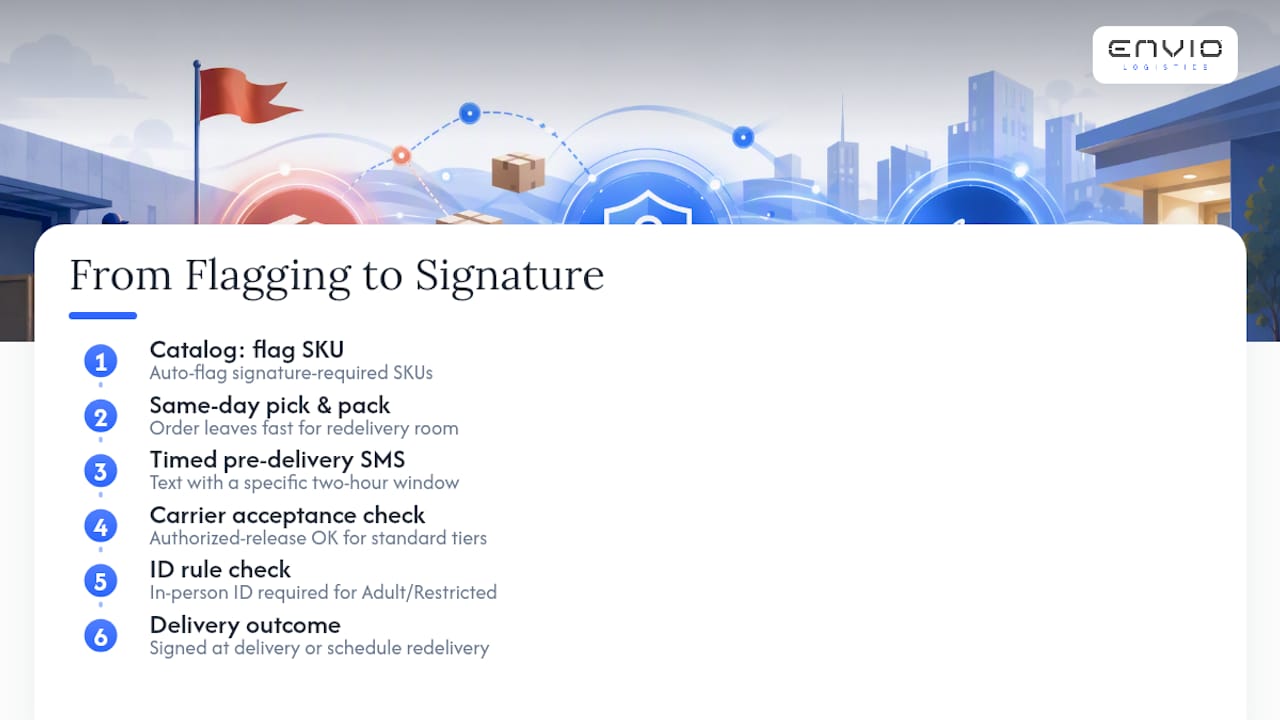
Authorized-release alternatives work for standard signature tiers, where a carrier accepts electronic authorization through its app or website. They do not work for Adult or Restricted Delivery, where an in-person ID check is the entire point of the service. Confusing the two is a common source of compliance gaps.

Pro Tip: If you outsource fulfillment, ask your partner for visibility into signature-related delivery outcomes and carrier billing. A fulfillment partner that reports failed-attempt rates and reconciles invoice line items catches the fees and delays that otherwise slip past a busy operations team.
A Shipping Manager’s Short Checklist
If you manage shipping for a growing catalog, prioritize in this order: compliance SKUs first, since a missed age check is a legal problem, not just an operational one. High-value items come next, where Direct signature protects you against chargeback disputes. Residential flexibility matters least urgently, but it’s where most of your order volume lives.
Practically, that means: tag every SKU that needs Adult or Direct signature in your product catalog, verify your label workflow actually applies those flags at scale, run a 60 to 90 day invoice audit for misapplied surcharges, and update customer-facing messaging so buyers know what to expect before the truck shows up. Track your failed-delivery rate and average redelivery days monthly. Those two numbers tell you whether your signature strategy is working or quietly costing you customers.
— Claudio Saenz
How Envio Helps You Manage Signature-Required Shipping
Getting signature rules right across hundreds of SKUs is a fulfillment problem as much as a shipping problem, and that’s where a managed partner earns its keep instead of leaving you to reconcile carrier invoices alone.

Envio Logistics, Inc enforces signature rules at the SKU level inside the fulfillment workflow itself, so a restricted item never leaves the warehouse without the correct tier applied. Same-day pick and pack means a missed first delivery attempt still leaves room to recover before a customer gets frustrated. You also get inventory data and reporting, so tracking failed-delivery rates and reconciling signature surcharges against carrier invoices is simpler. No long-term contracts allow clients to test whether tighter signature controls reduce failed deliveries before committing further. If your current setup leaves signature enforcement to memory and manual checks, see how Envio’s warehousing and fulfillment services handle it at the SKU level, or request a quote to walk through your specific catalog.
Sources
- What is Signature Confirmation™?
- 503 Quick Service Guide | Postal Explorer
- FedEx delivery options and signature services
- UPS signature-required and shipping services
- FedEx & UPS Delivery Signature Options: A 2026 Guide for Operations Teams
FAQ
What happens if a package requires a signature and no one is home?
The carrier leaves a notice and holds the package at a local facility, typically for three to five business days, before attempting redelivery or returning it to the sender.
How do I tell if my package requires a signature?
Check the tracking details or shipping confirmation email, which will list the specific service, such as Signature Confirmation, Adult Signature Required, or Direct Signature, and most carriers also display this on the delivery notice left at the door.
How much does it cost to send a USPS signature required package?
USPS Signature Confirmation costs less than Adult Signature Required, with Adult tiers across major carriers running close to $10.00 per package in 2026, though commercial postage rates often bring USPS fees in lower than retail counter pricing.
What happens if I miss my USPS delivery that requires signature?
USPS leaves a redelivery notice and holds the package at the local post office, and you can typically schedule redelivery online, request a hold for pickup, or authorize release electronically depending on the signature tier selected.
Does Envio Logistics, Inc handle signature-required shipments for merchants?
Yes. Envio Logistics, Inc enforces signature rules at the SKU level during fulfillment and provides reporting to track failed deliveries and reconcile carrier invoices for signature surcharges.
0 comments