
USPS is usually the lower-cost pick for light retail parcels, and it alone reaches PO Boxes and military addresses. FedEx usually wins when you need guaranteed overnight or premium express delivery. Weight, box dimensions, delivery speed, residential versus commercial destinations, and surcharges can flip that verdict, so run live rates on your own SKUs before committing.
TL;DR:
- USPS Ground Advantage covers packages up to 70 pounds in 2–5 days, with tracking and $100 insurance; Priority Mail Express takes 1–3 days and includes a refund guarantee.
- Free USPS flat rate boxes can beat zone based pricing for small, dense shipments, while Priority Mail retail prices start at $11.50.
- Both carriers bill bulky parcels by dimensional weight when it exceeds scale weight; divide length × width × height by 139 to calculate it.
- FedEx Express services offer guaranteed delivery dates, while residential, fuel, dimensional weight, and signature fees can raise invoices beyond quoted rates.
- Test representative parcels across both carriers for a month, compare invoiced costs, delivery time variation, claims, and complaints, then route each SKU or zone accordingly.
Table of Contents
- How do FedEx and USPS compare at a glance?
- What does FedEx do best, and when should you use it?
- What does USPS do best, and when should you use it?
- How do surcharges and dimensional weight change your real cost?
- How do you choose between USPS and FedEx for your shipments?
- Why do multi-carrier strategies and invoice audits matter for small shippers?
- Our take: price, speed, or outsourcing?
- How can we take carrier management off your plate?
- FAQ
- Sources
How do FedEx and USPS compare at a glance?
| Factor | USPS | FedEx |
|---|---|---|
| Pricing shape | Strongest on light parcels; flat-rate boxes help on dense items | Competitive on heavier ground parcels with account pricing; premium on express |
| Ground transit | USPS Ground Advantage: 2–5 days | FedEx Ground and Home Delivery: roughly 1–5 days by zone |
| Faster options | Priority Mail (2–3 days), Priority Mail Express (1–3 days) | FedEx Express Saver, Two Day, Standard Overnight, Priority Overnight, First Overnight |
| Guarantee | Priority Mail Express money-back guarantee | Day-definite guarantees on express services |
| Included insurance | $100 on many services | Declared-value coverage, higher values at added cost |
| Address coverage | PO Boxes, military addresses | Street addresses, commercial and residential |
| Common surcharges | Dimensional weight, nonstandard fees, hazmat handling | Residential, fuel, dimensional weight, signature services |
| Best for | Light parcels, flat-rate shipping, PO Box deliveries | Time-sensitive shipments, heavier ground freight, business accounts |
A few points to take from this comparison:
- Weight and size decide the winner. A light package and a heavy package rarely favor the same carrier.
- Speed costs more. Overnight tiers carry a clear premium, so use them only when a delivery date matters.
- Surcharges narrow the gap. A low headline rate can lose to a higher one once fees are added.
- Run a live rate check on three to five representative SKUs and zones before you change carriers.
What does FedEx do best, and when should you use it?
FedEx runs two distinct networks: ground and express. Knowing which one you are buying matters more than the brand name.
FedEx Ground and FedEx Home Delivery handle non-urgent parcels. Ground serves commercial addresses and Home Delivery focuses on residences, including weekend options. Shippers with steady volume, mixed box sizes, and business-rate agreements tend to prefer them over retail postage. Transit time depends on the zone.
FedEx express services cover the time-sensitive end of the spectrum:
- FedEx Express Saver: a guaranteed delivery option between ground and two-day services.
- FedEx Two Day: a delivery option for shipments that need to arrive faster than ground.
- FedEx Standard Overnight: an overnight delivery option.
- FedEx Priority Overnight: an overnight delivery option for urgent shipments.
- FedEx First Overnight: an overnight delivery option for urgent shipments.
Guaranteed delivery earns its extra cost when a missed date creates a bigger loss than the postage, such as replacement parts, event inventory, medical supplies, or high-value orders where customers expect a firm arrival.
The accessorials that most often raise FedEx costs:
- Residential delivery fees on home addresses
- Fuel surcharges that move with market conditions
- Dimensional weight charges on large, light cartons
- Signature and other special-handling services
Independent explainers such as this FedEx Ground, UPS Ground, and USPS comparison show how ground and two-day services stack up on price and transit for typical package profiles. If you are weighing FedEx against another large carrier too, our post on UPS vs FedEx for U.S. SMBs walks through a 30-day test you can run.
Pro Tip: Express wins the math when a late package triggers a refund, a chargeback, or a lost sale that costs more than the postage gap. Think of a replacement part shipped to a customer whose line is down: paying for Priority Overnight may be cheaper than the downtime.
What does USPS do best, and when should you use it?
USPS is often the cheapest way to move a light parcel, and it reaches places private carriers do not. Its lineup breaks down like this:
- USPS Ground Advantage: a 2–5 day domestic ground product for packages up to 70 lbs, with tracking and $100 insurance included, per the USPS Ground Advantage page. It consolidated several earlier ground products into one offering, as the USPS knowledge base explains.
- USPS Priority Mail: a 2–3 day service with free flat-rate boxes. Retail pricing starts at $11.50 at a Post Office, according to USPS service pages.
- Priority Mail Express: 1–3 day delivery with a money-back guarantee, starting at $37.05 at retail on the same pages.
Flat-rate packaging changes the math for dense items. If a box is small and heavy, a flat-rate price can beat any zone-based rate regardless of distance. Free packaging also saves a line item on your supply budget.
Three more advantages are easy to overlook:
- Included $100 insurance on many services, with higher-value protection listed on the USPS insurance and extra services page
- Delivery to PO Boxes and military addresses, which FedEx cannot match
- Business tools such as free package pickup and negotiated commercial pricing, covered on the Ground Advantage for Business page
Pricing is zone and weight based. USPS publishes retail Ground Advantage rates, with light tiers starting at $8.40 in certain zones.
Rules changed in 2026, and they matter if you ship large cartons. The USPS final rule on domestic competitive products documents a dimensional-weight divisor change, a new Hazmat Handling Fee, and updated cubic maximum measurements and nonstandard fees.

USPS standard on DIM weight: the divisor is 139 across the major carriers, as the USPS Postal Bulletin states, so a bulky, light carton gets billed on size rather than scale weight.
How do surcharges and dimensional weight change your real cost?
The rate on the website is rarely the rate on your invoice. Real landed cost includes every fee stacked on top, and those fees hit light, bulky packages hardest.
Dimensional weight works like this: multiply length by width by height, then divide by 139. The result is the billable weight if it exceeds the actual weight. A 24 × 18 × 12 inch box holding a 5 lb product comes to 5,184 cubic inches, which divided by 139 is about 37 lbs of billable weight. You would pay for 37 lbs, not 5. Our walkthrough of dimensional weight for small shippers shows how that kind of gap happens. Carton size caps matter too, and ForwarderOne’s guide to carton dimension limits is a useful reference when your packaging sits near the edge.
The fees that show up most often across carriers:
- Residential delivery fees
- Fuel surcharges
- Address correction fees
- Noncompliance and oversize or nonstandard dimension fees
- Hazmat handling fees
- Signature and special-service charges
Zone-driven pricing adds another layer, and our explainer on shipping zones and surcharges covers how distance bands shift cost.
Pitney Bowes makes the same point in its 2026 parcel shipping index: headline rates can hide surcharges, so watch revenue per parcel instead of sticker prices.
Steps to take control of these costs:
- Measure and record every SKU. Capture length, width, height, and weight of the packed box, not the bare product.
- Calculate DIM weight for each box. Use length × width × height ÷ 139 and compare it to scale weight.
- Shrink the box. Trim void space, switch to poly mailers where products allow, and drop one carton size up the ladder only when needed.
- Get business rates. Ask for commercial pricing or a rate card instead of paying retail.
- Audit invoices every month. Compare billed fees against what the rate card promised and dispute errors.
Pro Tip: Sort your SKUs by the gap between DIM weight and scale weight. The top five offenders usually account for most of your avoidable fees, so redesign their packaging first.
How do you choose between USPS and FedEx for your shipments?
Start with your own data. Generic comparisons only get you so far because your SKUs, zones, and customers decide the answer.
Work through this checklist:
- Pick representative SKUs: your lightest, your heaviest, and your best seller
- Map your top destination zones and the split between residential and commercial addresses
- Run live rates for both carriers with expected surcharges included
- Decide which shipments need guaranteed dates and which can tolerate a range
- Check insurance needs against what each service includes
- Weigh customer experience: delivery speed promises, weekend delivery, tracking quality
Then prove it in practice with a pilot:
- Split a slice of real orders. Send comparable parcels through each carrier over the same period.
- Track four KPIs. Record cost per parcel, delivery time variance, claim rate, and customer complaints.
- Compare after fees. Use invoiced totals, not quoted rates.
- Review by segment. One carrier may win light parcels while the other wins heavy or rural ones.
- Set routing rules. Assign each SKU or zone to the carrier that performed best.
A single carrier can become a single point of failure. Pitney Bowes recommends a multi-carrier strategy to avoid single-carrier risk and to route packages by real-time cost and performance, as laid out in its 2026 shipping index. Routing between USPS and FedEx gives you leverage in rate talks and a fallback when one network slows down.
Why do multi-carrier strategies and invoice audits matter for small shippers?
The market is shifting under shippers’ feet, and that creates room to negotiate. The same Pitney Bowes index reports 23.1 billion U.S. parcel shipments in 2025, with Amazon Logistics passing USPS in volume at 6.9 billion parcels. UPS lost market share while other carriers grew fastest. Its press commentary on carrier disruption frames that competitive pressure as an opportunity for shippers with multi-carrier access.
Pitney Bowes reports that UPS’s market share fell from 34% in 2024 to 31.6% in 2025, while USPS and FedEx revenue share stayed relatively flat. Pricing pressure is real, and shippers who can move volume between carriers hold the advantage. Source
What this means for a small or mid-sized brand:
- Base rates mislead. Accessorials such as residential fees, fuel surcharges, and nonstandard package charges often raise real cost well above the quote.
- Invoice audits pay for themselves. A routine monthly review catches billing errors and fee creep before they erode margin.
- Negotiated rate cards beat retail. Even modest volume can earn a business-rate agreement with either carrier.
- Outsourcing is a legitimate option. Our team handles carrier selection, packing, and shipping for brands that would rather not manage it, with same-day shipping on orders placed by 1PM CST and SKU profitability analysis that shows which products earn their keep. Our post on hidden 3PL pricing fees shows what to watch when you compare providers.
Our take: price, speed, or outsourcing?
If your parcels are light and your customers accept a few days, start with USPS and prove it against FedEx ground on your own data. Pay for FedEx express only where a missed date costs more than the premium. And if comparing carriers, auditing invoices, and tuning packaging is eating hours you would rather spend on product, outsourcing is a sound call. Test both carriers for a month either way, because your numbers beat any general rule.
— Claudio Saenz
How can we take carrier management off your plate?
You can keep comparing rates and auditing invoices yourself, or you can hand shipping to us. We run third-party logistics for small and mid-sized brands that have outgrown DIY fulfillment but are not ready for enterprise contracts.
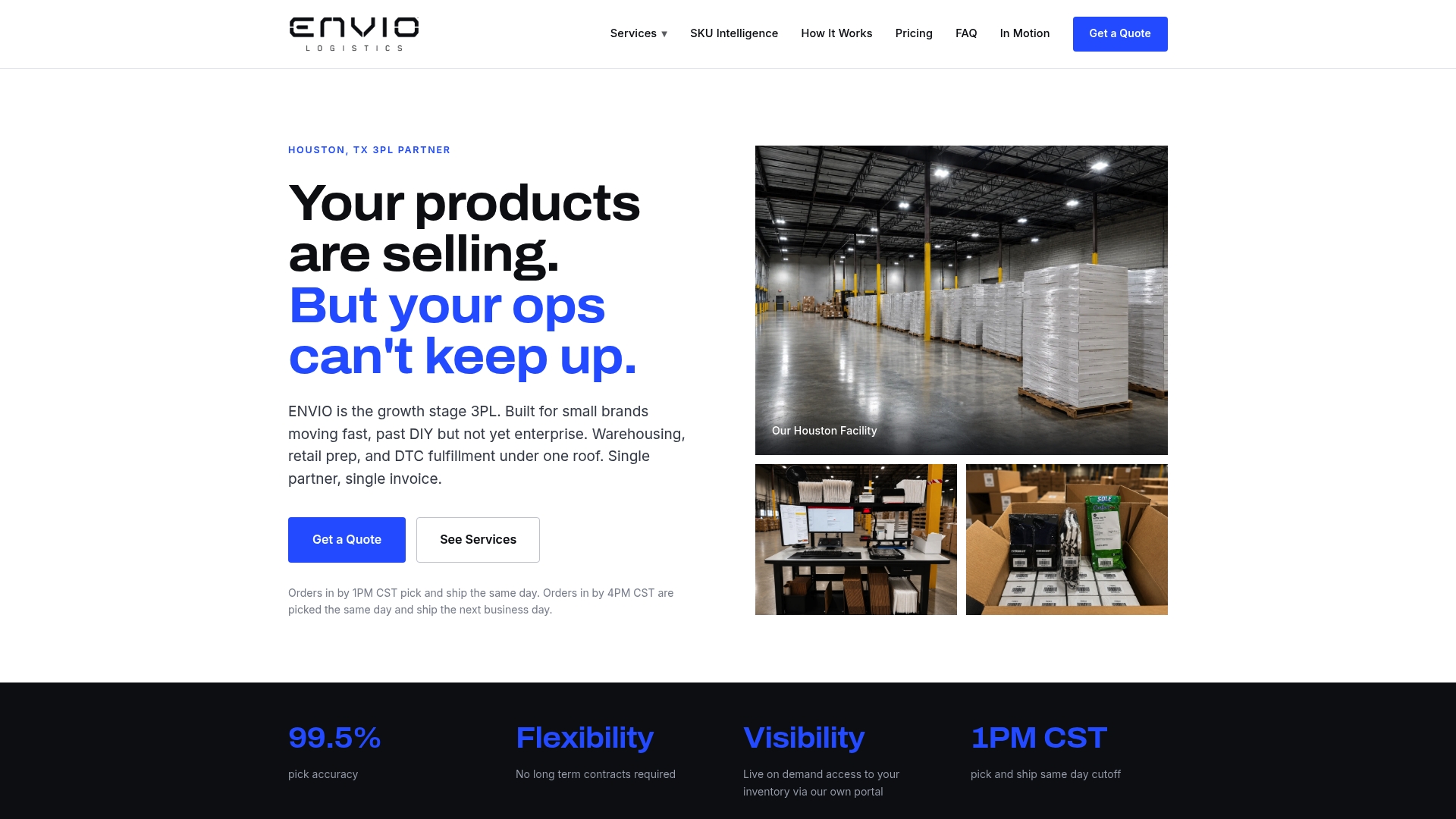
What we handle:
- DTC order fulfillment: single-unit and small-parcel orders picked, packed, and shipped, at $1.65 per order
- Same-day shipping: orders placed by 1PM CST leave the same day
- Live inventory visibility: a portal that shows stock as it moves
- SKU profitability analysis: a clear view of which products to scale and which to drop
- No long-term contracts: you stay in control of the relationship
Because we manage carrier selection and packing, you avoid DIM surprises and the vendor sprawl that hides costs. See our services and pricing or our 3PL fulfillment page, then request a quote.
FAQ
Is USPS or FedEx cheaper for shipping packages?
USPS is usually cheaper for light parcels, especially with flat-rate boxes and free packaging. FedEx ground can compete on heavier parcels when you hold a business-rate agreement. Run live quotes with surcharges included before deciding.
Which carrier is faster, FedEx or USPS?
FedEx offers more guaranteed fast options, including overnight tiers that deliver the next business day. USPS Priority Mail typically takes 2–3 days and Priority Mail Express 1–3 days, per USPS service pages. Choose FedEx when a firm date matters.
How does dimensional weight affect FedEx and USPS rates?
Both carriers bill the greater of actual weight or dimensional weight, calculated as length × width × height ÷ 139, per the USPS Postal Bulletin. A large, light box can cost far more than its scale weight suggests. Smaller packaging is the simplest fix.
Can I use more than one carrier?
Yes, and many growing brands do. Routing each SKU or zone to whichever carrier performs best lowers cost and reduces dependence on one network, as Pitney Bowes notes in its parcel shipping index.
Sources
- 2026 report
- Ground Advantage | USPS
- POSTAL SERVICE 39 CFR Part 111 Domestic Competitive Products Pricing and Mailing Standards Changes
0 comments