
TikTok Shop sellers now work with three fulfillment models: Seller Shipping, TikTok Shipping, and Fulfilled by TikTok (FBT). If you’re onboarding or reviewing your account, check your Seller Center settings now, because the platform is steering sellers toward managed fulfillment while Seller Shipping stays available to some accounts. Below, we break down each model, the current policy state, setup steps, delivery timelines, and a decision framework to help you pick the right path.
TL;DR:
- Seller Shipping gives you control over carriers and packaging, while TikTok Shipping assigns labels and carriers; FBT stores inventory and handles picking, packing, and delivery.
- TikTok has not announced a universal Seller Shipping cutoff, but onboarding rules can limit new accounts; confirm available options in Seller Center.
- US orders generally need 1 to 3 business days for processing and 3 to 7 for delivery; international shipping takes 7 to 14 business days.
- Compare total cost per delivered order, including inbound preparation and storage, against costs; postage alone can make a fulfillment model appear cheaper than it is.
Table of Contents
- What Seller Shipping, TikTok Shipping, and FBT actually are
- 2026 policy status: recent updates and how to read them
- How to set up shipping and warehouse settings in Seller Center and link integrations
- Dispatch SLAs, delivery timelines, and returns: what to track
- Decision framework: choosing Seller Shipping, TikTok Shipping, or FBT for your brand
- Publisher perspective: how a specialist 3PL can support TikTok Shop logistics transitions
- Envio: how our 3PL services support TikTok Shop sellers and next steps
- FAQ
- Sources
What Seller Shipping, TikTok Shipping, and FBT actually are
Each fulfillment model shifts responsibility differently between you and the platform. Knowing where the handoff happens determines how much operational work lands on your team.
- Seller Shipping puts you in full control: you choose carriers, print your own labels, and pack every order yourself.
- TikTok Shipping hands label generation and carrier selection to the platform, though packing often still happens in your own warehouse.
- FBT (Fulfilled by TikTok) moves inventory into TikTok’s fulfillment network, where picking, packing, and shipping are handled on your behalf.
The trade-off comes down to control versus convenience. Seller Shipping gives you the most flexibility over packaging and carrier relationships, but it also means every late scan or mislabeled box is yours to fix. FBT removes daily execution work, but it requires sending stock ahead of demand and trusting the platform’s handling standards. TikTok Shipping sits in between: you keep inventory on-site while offloading label and carrier logistics. None of these models are permanent choices. Many sellers run Seller Shipping while building toward FBT once their SKU mix and volume stabilize.
2026 policy status: recent updates and how to read them
TikTok communications have signaled a stronger push toward platform-managed logistics, and some sellers read this as the end of Seller Shipping altogether. TikTok later clarified that there was no blanket cutoff, though reporting on TikTok’s warehousing expansion confirms the platform is building out its own fulfillment infrastructure as part of a longer-term strategy to control more of the delivery experience.
What this means practically: don’t assume your account has a universal mandate either way. Onboarding rules may restrict new sellers to platform-managed logistics depending on account configuration, so verify your actual fulfillment permissions inside Seller Center rather than relying on forum chatter. The platform may incentivize FBT adoption through reimbursements and expanded support for weight tiers, which can make the managed option more attractive for sellers with predictable catalogs.

How to set up shipping and warehouse settings in Seller Center and link integrations
Getting your configuration right the first time avoids sync errors and missed dispatch windows down the line.
- Open Seller Center and set your warehouse location and default shipping preferences under the shipping settings tab.
- Confirm carrier assignment behavior. The platform may auto-assign USPS, UPS, or FedEx depending on package weight and destination, so check this before orders start flowing.
- Double-check package dimensions, processing time windows, and any handling rules tied to fragile or oversized items.
- Connect the official TikTok app for Shopify to keep orders and inventory synced automatically, which reduces oversells and missed service-level windows.
- If you already fulfill through Amazon FBA, look into Amazon Multi-Channel Fulfillment as a supported path to reuse that inventory for TikTok Shop orders through compatible integrations.
- Place a handful of test orders, watch how tracking updates populate, and run a low-volume pilot before scaling volume through any single model.
Pro Tip: Run your pilot orders during a slow sales window so you can catch sync issues before a traffic spike exposes them.
Our guide on avoiding oversells covers why relying solely on Shopify inventory apps often falls short once order volume climbs, and our multichannel fulfillment piece walks through piloting MCF reuse in more detail.
Dispatch SLAs, delivery timelines, and returns: what to track

US domestic TikTok Shop orders typically need 1 to 3 business days for processing and 3 to 7 business days for delivery, while international orders generally run 7 to 14 business days. FBT-eligible items can display a 3-day delivery badge as a conversion signal, but that badge isn’t a guarantee across every product or destination.
Fulfillment shapes commerce scale on the platform, and Statista’s e-commerce-on-TikTok data gives useful context for just how much order volume sellers are now managing through these fulfillment channels.
- Accurate dispatch scanning and carrier tracking matter because undelivered orders past the platform’s estimated delivery threshold may trigger automatic refunds in certain cases.
- Returns intake on the platform generally follows standard marketplace return windows, but the physical handling, inspection, and restocking work still falls on you or whoever runs your warehouse.
- Outsourcing returns intake and restocking is a common way sellers keep refund timelines tight without tying up in-house labor.
Decision framework: choosing Seller Shipping, TikTok Shipping, or FBT for your brand
Your choice should rest on a few concrete factors: order volume, how predictable your SKU mix is, how mature your warehouse operation already is, your tolerance for platform dependence, and how many other sales channels you’re juggling.
Three scenarios tend to cover most sellers:
- Keep Seller Shipping if your current fulfillment stack already runs smoothly and you need to retain carrier flexibility for cost or delivery reasons.
- Evaluate TikTok Shipping if you want to cut down on daily shipping execution but aren’t ready to hand inventory over to a third party.
- Consider FBT once your assortment and replenishment cycles are predictable enough to forecast inventory needs without constant adjustment.
Before switching models, measure a few numbers against your current baseline: cost per order, inbound prep cost to get goods warehouse-ready, and your on-time dispatch rate. A model that looks cheaper on paper can still cost more once inbound handling and storage fees are factored in, so compare total cost per delivered order rather than postage alone.
Publisher perspective: how a specialist 3PL can support TikTok Shop logistics transitions
Many sellers hit the same wall: they can handle fulfillment at low volume, but inbound prep, FBT-compliant packaging, and multichannel routing start eating time once order counts climb. A focused 3PL partner can absorb that work, handling inbound prep, returns intake, and live inventory sync so oversells and SLA misses happen less often with expert omnichannel and ecommerce fulfillment support.
Before signing with any 3PL, ask about daily order cutoff times, what integration support they actually provide, and how often you’ll get reporting on cost per order and fulfillment accuracy. Those three answers tell you more about fit than a sales pitch ever will.
— Claudio Saenz
Envio: how our 3PL services support TikTok Shop sellers and next steps
We built our fulfillment services around the gap that TikTok Shop sellers hit once DIY shipping stops scaling. Our DTC order fulfillment handles single-unit and small parcel orders, and we support the operational pieces that TikTok Shop logistics actually demands:
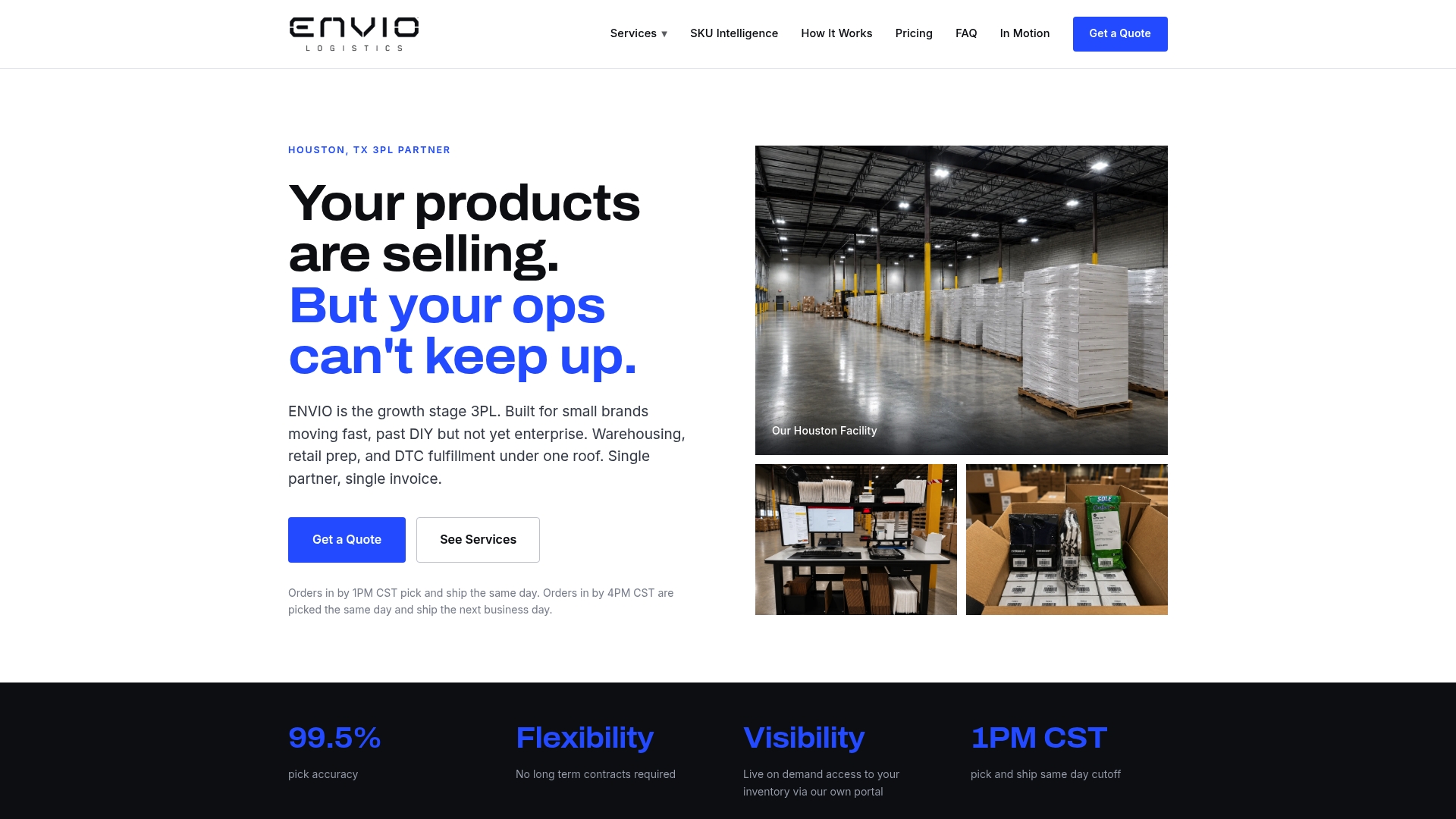
- DTC order fulfillment for TikTok Shop orders, billed per order with no long-term contract required.
- Amazon & Walmart prep services if you’re running multichannel and need FBA/WFS-compliant prep alongside your TikTok volume.
- Kitting and assembly for bundled SKUs that need to arrive as a finished unit.
- Returns intake, inspection, and restock so refund windows don’t pile up unmanaged inventory.
- Live inventory portal access so you can see stock levels in real time instead of guessing between platform syncs.
If you’re weighing a pilot, send us your average monthly order count, your SKU list, and any special packaging or kitting needs. We’ll turn that into a straightforward quote. Visit our 3PL & warehousing page for full service details, or request a quote directly through our services page to get started.
FAQ
How long does shipping take from TikTok Shop?
US domestic orders typically take 1 to 3 business days to process and 3 to 7 business days to arrive, while international orders generally run 7 to 14 business days. Some FBT-eligible items may display a 3-day delivery badge, though this isn’t guaranteed for every product or destination.
Can you refuse a TikTok delivery?
Delivery refusal depends on the carrier handling the shipment and the seller’s own return policy, since TikTok Shop itself doesn’t set a universal refusal rule across all orders. If a package is refused, it typically routes back through the seller’s standard returns process, which may involve inspection and restocking before a refund is issued.
How much do TikTok agencies charge?
Agency pricing varies widely depending on the scope of services, such as account management, content production, or paid promotion, and isn’t tied to a fixed industry rate. Costs depend heavily on the agency’s size, specialization, and the scale of the seller’s TikTok Shop operation.
Can you make money selling products on TikTok?
Selling profitably on TikTok Shop is possible, but it depends on factors like product margin, fulfillment costs, and how efficiently orders are processed and shipped. Sellers who track cost per order and keep dispatch times tight tend to protect margin better than those who treat fulfillment as an afterthought.
0 comments